What if the delusions of the dissidents are in fact real? What if their paranoid fantasies are not fantasies at all? Prepare yourself for Dissent Into Madness.
https://www.corbettreport.com/mp3/episode483-dim.mp3
What if the delusions of the dissidents are in fact real? What if their paranoid fantasies are not fantasies at all? In other words, what if it’s not the political dissidents who are crazy, but the politicians?
You’re about to learn about the dark history and the even more disturbing present of political psychopathy.
Prepare yourself for DISSENT INTO MADNESS.
Video player not working? Use these links to watch it somewhere else!
WATCH ON:
TRANSCRIPT (part 2)
Part 1: https://test.pareto.space/u/corbett-report@pareto.town/32c9b6d7e56039be26a8f3192dfa1db4
6. Our (Mis-)Leaders Are Psychopaths

They are “remorseless predators who use charm, intimidation, and, if necessary, impulsive and cold-blooded violence to attain their ends.”
They “ruthlessly plow their way through life, leaving a broad trail of broken hearts, shattered expectations, and empty wallets.”
They have “no feelings of guilt or remorse no matter what [they] do, no limiting sense of concern for the well-being of strangers, friends, or even family members.”
Am I talking about politicians? Technocrats? Billionaire “philanthrocapitalists”? Royalty? Captains of industry?
Of course I am. But I’m also talking about psychopaths.
We all know what a psychopath is, or at least we think we do. They’re chainsaw-wielding, crazed serial killers, like Leatherface from The Texas Chainsaw Massacre. Or they’re knife-wielding, crazed serial killers, like Buffalo Bill from The Silence of the Lambs. Or they’re acid-spraying, lapel-flower-wearing, crazed serial killers, like The Joker from Batman.
But if that is what we think of when we think of a psychopath, we find that once again we are the victims of Hollywood predictive programing, constructing our understanding of reality not from actual, lived experience but from fictional characters dreamt up by writers and projected on a screen.
In the real world, psychopaths are a subset of the population who lack a conscience. The full implications of this strange mental condition are not apparent to the vast majority of us who do possess a conscience and who assume that the inner life of most people is largely similar to our own.
In The Sociopath Next Door, Dr. Martha Stout, a clinical psychologist who has devoted much of her career to the subject, demonstrates what the absence of a conscience really means by inviting her readers to participate in this exercise:
Imagine—if you can—not having a conscience, none at all, no feelings of guilt or remorse no matter what you do, no limiting sense of concern for the well-being of strangers, friends, or even family members. Imagine no struggles with shame, not a single one in your whole life, no matter what kind of selfish, lazy, harmful, or immoral action you had taken. And pretend that the concept of responsibility is unknown to you, except as a burden others seem to accept without question, like gullible fools. Now add to this strange fantasy the ability to conceal from other people that your psychological makeup is radically different from theirs. Since everyone simply assumes that conscience is universal among human beings, hiding the fact that you are conscience-free is nearly effortless. You are not held back from any of your desires by guilt or shame, and you are never confronted by others for your cold-bloodedness. The ice water in your veins is so bizarre, so completely outside of their personal experience, that they seldom even guess at your condition.
The possibilities for manipulation, deceit, violence and destruction that this condition presents should be obvious by this point. And indeed, as a number of books by psychologists and researchers studying psychopathy—from Howard Cleckley’s seminal 1941 work, The Mask of Sanity, to Robert Hare’s popular book, Without Conscience, to Andrew Lobaczewski’s rescued-from-the-dustbin-of-history-by-an-independent-publisher opus, Political Ponerology—have repeatedly tried to warn the public over the years, psychopaths do exist. They represent something like 4% of the population, and they are responsible for much of the havoc in our society.
So, how do we know who is a psychopath? That, as you might imagine, is a highly contested question. While various biomedical explanations for the condition have been proffered—dysfunction of the amygdala and ventromedial prefrontal cortex, for example—and dozens of studies to determine the relationship between brain physiology and psychopathy have been conducted in the past half-century, psychopathy is most commonly diagnosed by way of the Psychopathy Checklist, Revised, known as the PCL-R.
Devised by Robert Hare—the most influential psychopathy researcher of the past half-century—the PCL-R involves, among other things, a semi-structured interview in which a subject is tested for 20 personality traits and recorded behaviours, from “egocentricity/grandiose sense of self-worth” to “pathological lying and deception” to “lack of remorse or guilt” to “early behaviour problems.”
Although none of these personality traits are indicative of psychopathy by themselves, the presence of a certain number of them (corresponding to a score of 30 or higher on the PCL-R test) is used to diagnose the condition.
So, how would your average politician score on this test? Let’s find out.
Egocentricity / grandiose sense of self-worth?
Pathological lying and deception?
Conning / lack of sincerity?
Lack of remorse or guilt?
Callous / lack of empathy?
Parasitic lifestyle?
Isn’t that the definition of a career politician?
Check.
Early behaviour problems?
Check. (Actually, this one is straight from Stout’s book . . . but her story of the young boy who uses his “Star-Spangled Banner” firecrackers in their skull-and-crossbones-emblazoned box to blow up frogs is just a “composite” case that isn’t meant to represent anyone in particular, of course.)
I could go on, but you get the idea.
To be fair, a cherry-picked list of isolated examples of politicians’ behaviour like this is not enough to diagnose anyone as a psychopath and, by itself, should not convince you of anything. Nor should you be convinced by the psychologists who have offered their professional opinion on politicians they have not themselves examined—like neuropsychologist Paul Broks, who, in 2003, speculated as to whether Tony Blair was “A Plausible Psychopath?,” or professor of psychology David T. Lykken, who, in the Handbook of Psychopathy, argues not just that Stalin and Hitler were high-functioning psychopaths but that Lyndon B. Johnson “exemplified this syndrome.”
So, is it fair to suspect that psychopaths are overrepresented in the political class? According to Martha Stout, it is:
Yes, politicians are more likely than people in the general population to be sociopaths. I think you would find no expert in the field of sociopathy/psychopathy/antisocial personality disorder who would dispute this. [. . .] That a small minority of human beings literally have no conscience was and is a bitter pill for our society to swallow—but it does explain a great many things, shamelessly deceitful political behavior being one.
For whatever it’s worth, certain members of the UK government agree with Stout’s assessment. In 1982, one UK Home Office official suggested “recruiting psychopaths to help restore order in the event England is hit by a devastating nuclear attack.” And the reasoning behind this official’s surprising suggestion? The fact that psychopaths “have no feelings for others, nor moral code, and tend to be very intelligent and logical” means they would be “very good in crises.”
To be sure, the a priori case for the utility of psychopathic traits in political office is fairly obvious, but empirical data to back up this intuition is hard to come by. After all, politicians, corporate chieftains, royals, and bankers are not administered a PCL-R test before assuming their office or position.
Nonetheless, a number of researchers have offered some data that supports the political and corporate psychopathy thesis. They include:
-
Clive Boddy, a professor at Anglia Ruskin University who argues that “[e]vidence for the existence of white-collar psychopaths comes from multiple studies which have found psychopathy among white collar populations”;
-
Dr. Kevin Dutton, an Oxford University psychologist who used a standard psychometric tool—the Psychopathic Personality Inventory (Revised)—to score a number of current and historical political personages, finding that Donald Trump, Hillary Clinton, and Ted Cruz scored relatively high on the test (along with Winston Churchill, Adolf Hitler, and Saddam Hussein);
-
Scott O. Lilienfeld, a professor of psychology at Emory University who led a study of the 43 US presidents up through George W. Bush, demonstrating that certain psychopathic personality traits directly correlate with political success; and
-
Ryan Murphy, research associate professor at Southern Methodist University whose 2018 study concluded that Washington, D.C., had the highest prevalence of personality traits corresponding to psychopathy in the continental U.S. (and also found that the concentration of lawyers is correlated to the prevalence of psychopathy in a geographic area).
Even Robert Hare—who has coauthored one of the few empirical studies confirming a higher prevalence of psychopathic traits among corporate professionals in management training programs than in the general population—has said that he regrets spending most of his career studying psychopaths in prison rather than psychopaths in positions of political and economic power. When questioned about this regret, he noted that “serial killers ruin families” while “corporate and political and religious psychopaths ruin economies. They ruin societies.”
The fact that the key positions of political, financial, and corporate power in our society are dominated by psychopaths certainly helps to explain why our society is as profoundly sick as we non-psychopaths know it to be. For those who still believe that our sick society can be cured by recourse to the political process, this seems like the worst news imaginable.
... But actually it’s even worse than that. These political psychopaths don’t just ruin societies. They reshape society in their own image.
7. Projections of the Psychopaths

In psychology, “projection” refers to the act of displacing one’s own feelings onto another person. As Psychology Today explains:
The term is most commonly used to describe defensive projection—attributing one’s own unacceptable urges to another. For example, if someone continuously bullies and ridicules a peer about his insecurities, the bully might be projecting his own struggle with self-esteem onto the other person.
This concept of projection equips us to better understand why political psychopaths pathologize conspiracy theorists and political dissenters: they are projecting their own mental disorders onto their ideological opponents.
But there is another sense in which psychopaths are “projecting” their pathology onto the world stage. You see, psychopaths don’t merely take advantage of their lack of conscience to obtain political or economic power. They use that power to shape the organization they’re leading into a projection of their own psychopathic tendencies.
ROBERT HARE: The psychopath’s relations with others are superficial. Surface. Very, very little depth. Mostly style over substance. And the idea is to impress other individuals to somehow put them in a position where you can manipulate them, and so forth.
And a corporation I imagine would be not unlike that in many respects. They would have public relations firms. They would be spending half their time and a lot of their budget on trying to present a particular image to other people. And this image is very superficial and you never really get to know the real corporation. You’re going to see what they want you to see.
In one memorable scene from the 2003 documentary, The Corporation, Robert Hare points out that a corporation under the management of a psychopath could itself be diagnosed as psychopathic. Thus, the egocentric and narcissistic tendencies of the psychopath boss are reflected in the development of the corporation’s public relations. The psychopath’s capacity for guilt-free deception and manipulation of others is reflected in the company’s advertising and marketing material. The psychopath’s willingness to commit crimes without shame in pursuit of his objectives finds its analogue in the corporation’s willingness to flagrantly break the law. And the psychopath’s utter lack of remorse for his crimes is mirrored by the corporation’s cynical calculation that fines and punishments for its illegal acts are merely the “cost of doing business.”
But the psychopath does not stop at turning an organization into a projection of his own perverted personality. Be it a business, a bank, or, in the case of a political psychopath, an entire nation, the organization under his control eventually starts to change the character and behaviour of the employees or citizens under its thumb.
The idea that psychopathic systems can make non-psychopaths act like psychopaths might, at first glance, go against our moral intuitions. Surely, we reason, people are either “good people” or “bad people.” They are either psychopathic or sane. They are either the type of person who commits a terrible crime or they aren’t.
As it turns out, however, our reasoning has been proven wrong by research into “secondary psychopathy.” This category of psychopathy, sometimes referred to as sociopathy, is meant to differentiate primary psychopaths—those born with a “lack of conscience” and its associated neurocognitive impairments discussed by Hare, Stout and others—from secondary psychopaths, who develop psychopathic traits as a result of the environment they are functioning in.
Many experiments have been conducted over the decades researching the phenomenon of secondary psychopathy and how “good people” can be placed in situations wherein they will do “bad things,” from the seemingly mundane Asch conformity experiment, which showed that people are often willing to state and even believe demonstrable lies in order to avoid breaking a group consensus, to the truly shocking Milgram experiment, which famously demonstrated that ordinary people could be induced to deliver what they believed to be potentially fatal shocks to strangers on the say-so of an authority figure.
But perhaps the most revealing experiment for the purposes of understanding secondary psychopathy is the Stanford Prison Experiment.
Led by Stanford psychology professor Philip Zimbardo, this 1971 experiment involved recruiting participants from the local community with an offer of $15 per day to participate in a “psychological study of prison life.” The recruits were then screened to eliminate anyone with psychological abnormalities, and the remaining candidates were randomly assigned as either guards or prisoners and told to prepare for two weeks of life in the basement of Stanford’s psychology building, which had been converted into a makeshift prison.
The results of that experiment are, by now, infamous.
Immersing the participants in the role play with realistic surprise “arrests” of the prisoners by real Palo Alto police officers, the exercise quickly descended into a study in cruelty. The prison “guards” quickly devised more and more sadistic ways to assert their authority over the “prisoners,” and two of the students had to be “released” from the prison in the first days of the ordeal due to the mental distress it had placed on them. The experiment was called off after just six days, with the researchers finding that both the prisoners and guards had exhibited “pathological reactions” to the mock prison situation.
How did this happen? How did otherwise average, healthy young men descend into such barbarity in less than one week?
In his book The Lucifer Effect: How Good People Turn Evil, which documents that study as well as subsequent decades of research he did into the psychology of evil, Zimbardo reflects on how a system can reflect the pathologies of those who created it and how it can, in turn, influence individuals to commit evil acts: “unless we become sensitive to the real power of the System, which is invariably hidden behind a veil of secrecy, and fully understand its own set of rules and regulations, behavioral change will be transient and situational change illusory.”
The true import of this lesson was felt three decades later, when the US began its detention of prisoners at the Abu Ghraib prison in Iraq. The physical, psychological, and sexual abuse of prisoners at Abu Ghraib was brought to the attention of the world in April 2004, when graphic images of the abuse were first published in American media.
Once again, the public began to question how the otherwise average young American men and women who had been assigned to the prison as military police guards could have committed such incredibly sadistic acts.
That question was answered in part by the Senate Armed Services Committee report on the Abu Ghraib abuses. The report details then-Secretary of Defense Donald Rumsfeld’s approval of a request to use “aggressive interrogation techniques” on detainees, including stress positions, exploitation of detainee fears (such as fear of dogs), and waterboarding. It recounts how Rumsfeld added a handwritten note to the request’s recommendation to limit the use of stress positions on prisoners: “I stand for 8-to-10 hours a day. Why is standing limited to 4 hours?” And it condemns Rumsfeld for creating the conditions by which his approval could be interpreted as a carte blanche to initiate torture of detainees: “Secretary Rumsfeld authorized the techniques without apparently providing any written guidance as to how they should be administered.”
It should come as no surprise, then, that, as even a cursory review of Donald Rumsfeld’s career will demonstrate, he exhibited several of the personality traits on the PCL-R checklist, including pathological lying and deception, callous behaviour, and failure to accept responsibility for his own actions.
DONALD RUMSFELD: It appears that there were not weapons of mass destruction there.
RAY McGOVERN: You said you knew where they were.
RUMSFELD: I did not. I said I knew where suspects sites were, and we were just—
McGOVERN: You said you knew where they were, “near Tikrit, near Baghdad and North, East, South and West of there.” Those are your words.
SOURCE: Ray McGovern Owns Donald Rumsfeld – Rummy denies his own words
RUMSFELD: We know they have weapons of mass destruction. We know they have active programs. There isn’t any debate about it.
SOURCE: The Unknown Known
The connection between the Stanford Prison Experiment and what happened at Abu Ghraib didn’t escape the attention of investigators. The so-called “Schlesinger Report” on detainee abuses included an entire appendix recounting the Stanford experiment and what it taught about how secondary psychopathy can be induced in those working in a system or institution.
Nor did the connection between Stanford and Abu Ghraib escape the attention of the public. After revelation of the Abu Ghraib abuses in 2004, the Stanford Prison Experiment website’s traffic exploded to 250,000 page views per day.
What most of the public do not know, however, is that the funding for the Stanford Prison Experiment came from the Office of Naval Research, which provided a grant “to study antisocial behaviour.” It seems that the military psychopaths certainly did learn the lessons of that experiment—and then promptly weaponized them.
Whatever the case, although nothing in any of these experiments or research exonerates any individual from the evil deeds that they have committed, these findings do shine a light on the problem of secondary psychopathy.
How much of the madness of our society is a projection of the psychopaths who are running it?
8. Pathocracy
Statist propaganda in the West tries to convince us that we live in a democracy, exemplifying Abraham Lincoln’s famous ideal of “government of the people, by the people, for the people.”
But this is gaslighting. In truth, we live in a pathocracy, which, borrowing from Lincoln, might be described as “government of the psychopaths, by the psychopaths, for the psychopaths.”
Although “pathocracy” is still a foreign concept to many, it is by now a well-established and thoroughly documented phenomenon. The term was coined by Andrew Lobaczewski—a Polish psychologist whose life’s work was shaped by his experience growing up first under the thumb of the brutal Nazi occupation and then under the equally brutal Soviet regime—in his book, Political Ponerology.
Lobaczewski defines pathocracy as a system of government “wherein a small pathological minority takes control over a society of normal people.” Then, in a chapter of Political Ponerology devoted to the subject, he describes how pathocracies develop, how they consolidate power, and how they trick, cajole, intimidate, and otherwise induce non-psychopaths into participating in their madness.
How can soldiers’ natural aversion to pulling the trigger on complete strangers be overcome? How can doctors who have sworn an oath to do no harm participate in the scamdemic madness of recent years? How can regular, salt-of-the-earth, working-class policemen be induced to brutally beat peaceful protesters? These are the questions that keep both the pathocrats in power and those looking to escape the pathocracy up at night, albeit for very different reasons.
Thankfully, we do not need to ponder these questions in a vacuum. In fact, the conditions for creating an environment in which the average person can be induced to participate in evil acts has been studied, catalogued, and discussed by psychologists for the better part of a century. Unsurprisingly, though, this research, ostensibly intended to better understand how people can guard against such manipulation, has instead been weaponized by the pathocrats and used to fine-tune the creation of systems for generating more obedient order-followers. In fact, this was part of the point of the well-known but almost completely misunderstood Milgram experiments.
At this point in our exploration, we are finally beginning to grasp the full extent of the problem posed by psychopaths in positions of political, corporate, and financial power.
The problem isn’t just that psychology has been weaponized against those of us who would engage in political dissent.
And the problem isn’t simply that this system for suppressing and pathologizing dissent has been created by literal psychopaths and their sociopathic lackeys.
The problem is that the state itself is psychopathic and is actively warping the morals of otherwise mentally sound individuals, causing them to adopt psychopathic traits in return for material reward and positions of authority.
This is the problem of pathocracy.
Once we realize the gravity of this situation, the obvious question presents itself: how do we throw off the yoke of the political psychopaths and topple their pathocracy?
As usual, the quality of our answer to this question is directly dependent on the depth of our understanding of the underlying problem.
For example, we might be tempted to ask if we can find a way to eliminate psychopaths from all positions of power.
But this is a misunderstanding of the problem itself. If there are in fact many psychopaths who are all vying with each other for political control, then we have to understand that eliminating the current political psychopaths would merely open the door for others to step into those vacant positions. Worse, given the psychopathic nature of the power structure as it exists, the system itself actually ensures that psychopaths and sociopaths who, by definition, show no remorse or moral qualms about hurting others, will end up winning the vicious battle to fill the top spots in the political hierarchy.
Only when we step back and interrogate the political system as a whole can we appreciate that the very existence of those seats of power from which a handful of individuals can rule over the masses is itself a construct of the pathocracy. Unless and until those seats of power are eliminated altogether, we will never rid ourselves of the struggle for dominance that rewards the psychopaths with control over others.
The elimination of these seats of power, however, will not happen until we overturn the underlying assumption that centralization of power is necessary in the first place.
So, for those of us morally sound individuals currently living under the rule of the psychopaths, the question remains: what can we possibly do to overthrow the pathocracy?
As it turns out, the answer to that question may in fact be much simpler than we think.
9. Circuit Breaker
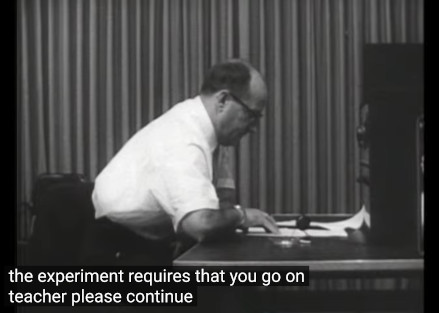
In the 1960s, psychologist Stanley Milgram set out to study the extent to which people’s blind obedience to perceived authority influences their behaviour. It was with this goal in mind that Milgram began his infamous study of obedience on August 7, 1961.
The results of those experiments, well-known to the public by now, ostensibly demonstrate that average, everyday people can be induced to deliver what they believe to be potentially lethal electric shocks to complete strangers based solely on the say-so of an authority figure. This finding is most commonly summarized with the factoid that a whopping 65% of participants in the original 40-person study were willing to deliver a 450-volt shock—what they were led to believe could be a potentially lethal shock—to an audibly distressed person based on nothing more than a prompt from a person in a lab coat wielding a clipboard.
As one of the most famous psychological studies of the 20th century, the Milgram experiments have generated no end of debate, controversy and scrutiny. The NPR-promoted critics of the experiments, who contend that most of the study’s participants knew that the entire situation was phoney and that they disobeyed even more often than was reported, are often pitted against the establishment psychologist defenders of the experiment, who correctly note that the experiments’ shocking (pun intended) conclusions have been independently reproduced time and time and time again in country after country around the world. (In one particularly twisted reproduction, the researchers even sought to ensure that no subject would suspect the experiment was fake by delivering real electric shocks to cute puppies.)
What almost everyone misses about the Milgram experiments, however, is that the study was not one experiment that was conducted on one set of 40 participants one time to yield one final result. In fact, Milgram conducted the experiment a total of 17 times with 17 separate cohorts of 40 to 60 test subjects, with each iteration of the study employing a number of experimental variations.
In one variation, he changed the site of the study from the Yale University campus to a rundown office building. In another variation, the test subjects were allowed to instruct an assistant to deliver the shocks instead of pressing the switch themselves. In still another variant, the lab coat-wearing actor playing the “experimenter” was called away on business and replaced by an ordinary man wearing a suit. And in yet another variation, the test subject was obliged to wait and watch another actors become the “teacher” and go through the experiment before assuming the role himself.
Each variation produced markedly different results. When the test subject could instruct someone else to deliver the shocks instead of doing it himself, for instance, the percentage of participants willing to deliver the maximum (supposedly potentially lethal) shock rose to an incredible 92.5%. When the experiment took place in an office building instead of on the Yale campus, the number willing to administer the maximum shock dropped to 48%. And when the test subject watched other people take the “teacher” role before them and observed them refusing to obey the experimenter’s command to deliver the shocks, that subject’s willingness to deliver the maximum shock plummeted to 10%.
Let me rephrase that for the hard of thinking. When the test subject saw someone disobey the experimenter, they themselves refused to proceed with the experiment 90% of the time.
This is the surprising conclusion that has been scrubbed from most accounts of the Milgram experiments: Disobedience, once modeled, becomes an option in the mind of the public.
This point is crucial to understand because, exactly as Étienne de La Boétie pointed out nearly 500 years ago, a small cadre of tyrants, no matter how psychopathically menacing, are incapable of administering a tyranny all by themselves. They require the active participation of a much larger number of obedient order-followers.
Indeed, it’s important to become conscious of the fact that none of the worst excesses of the pathocracy in recent times would have been possible without the active participation of vast swaths of the population. So-called vaccine “mandates” were not achieved by one psychopath in a position of political authority, or even by a gaggle of such pathocrats. They were enabled by the doctors who participated in the vaccination drives against their own experience, judgment, and training; the employers who imposed vaccine requirements on their employees; the business owners who implemented vaccine certificate checks on their premises; the police officers who threw the unvaccinated in quarantine facilities; the workers who kept those quarantine centers functioning; the judges and lawyers who rubber-stamped all these actions, etc.
The same goes for any number of pathocratic abuses that we’ve been subjected to in recent years. These programs can only be implemented when most of the people comply with their orders and thus fulfill their role in the operation.
Just as in the time of La Boétie, our enslavement to the pathocracy is, by and large, a voluntary servitude born of obedience.
Combining La Boétie’s insight with Milgram’s lesser-known experimental results, then, we find a template for toppling the pathocracy: highly visible acts of disobedience.
But is this true? Can a single act of disobedience really bring down a pathocracy?
Once again, we don’t have to speculate about this possibility in a vacuum. Thanks to the wonders of modern technology, we can actually watch a recording of such an event happening in real time.
On December 21, 1989, Romanian dictator Nicolae Ceaușescu took to Palace Square to address the Romanian people. At first, it proceeded like any number of such speeches he had delivered over the years. He talked about the successes of Romania’s socialist revolution and sang the praises of the “multi-laterally developed Socialist society” that had arisen under his brutal reign.
But then, something extraordinary happened. Someone booed. The boo was taken up by others and became a jeer. Chants of “Timișoara!” rippled through the crowd, a reference to a massacre of political dissidents by Ceaușescu’s security forces that had taken place just days earlier.
The dictator, unused to any sign of dissent from the population over whom he had ruled so brutally for decades, called for order. His wife demanded the crowd’s silence, prompting Ceaușescu to tell her to shut up, and then he attempted to continue with his speech. But the jeers began again.
The footage of the incident, including Ceaușescu’s look of utter confusion as he realizes that the crowd has turned against him and that the threat of violence is not enough to subdue them, is priceless. There, captured on tape for posterity, is the moment when the realization dawns on the tyrant that the people have rejected his tyranny. The rest of the story—the riots and unrest, the attempted escape of Ceaușescu and his wife, their capture by military defectors and their execution on Christmas Day—all stems from that precise moment when one person in the crowd simply voiced what the rest of the crowd was feeling.
This is the circuit-breaker effect. By saying no to illegitimate authority, resisting bullies and tyrants, disobeying immoral orders, refusing to comply with unjust mandates and demands, we make it that much easier for those around us to stand up for what they, too, know to be right.
But wait, it gets even better...
First, the good news: pathocracies are inherently unstable and they are doomed at some point to topple under their own weight.
Next, the even better news: if it’s true that psychopaths can fashion a psychopathic society that twists people into sociopaths, then the opposite is true, too. Healthy, non-pathological humans with love, empathy, and compassion can fashion a society that brings out the better side of human nature.
This is the real goal of the erstwhile victims of the pathocrats. Not to eliminate the political psychopaths and assume their positions of power in the psychopathic political system that they created, or even to abolish that system altogether, but to envision a world in which compassion, cooperation, love and empathy are not just encouraged but actively rewarded. A world in which every person is allowed to become their best possible self.
It’s up to each one of us to model what we want to see in the world. Just like the brave dissenter who can break the circuit of tyranny by voicing opposition to the tyrant, we can also become the models of love, understanding and compassion that will motivate others to become the same.
The psychopaths have spent centuries weaponizing psychology to more effectively control us. But we can wield our understanding of human nature for something good. And isn’t that what healthy, non-psychopathic individuals forming a healthy, non-psychopathic society would spend their time and resources doing?