Your digital papers, please!? Why we must defend the right to an analog life.
The asymmetry of the world: A few know everything about many (graphic: AI)
This article first appeared in German at Freischwebende Intelligenz. You can find all the articles by Free-floating Intelligence in English here – subscribe now, to get the articles by e-mail! This article has been written with the Pareto client.
Get the latest articles from Free-floating intelligence by subscribing to the newsletter.
Get the latest Pareto articles via Telegram.
I live in Switzerland and want to find out about the upcoming vote on e-ID. So I go to the newsstand and say, “One NZZ, please.” “Can I see your ID first?” asks the salesperson.
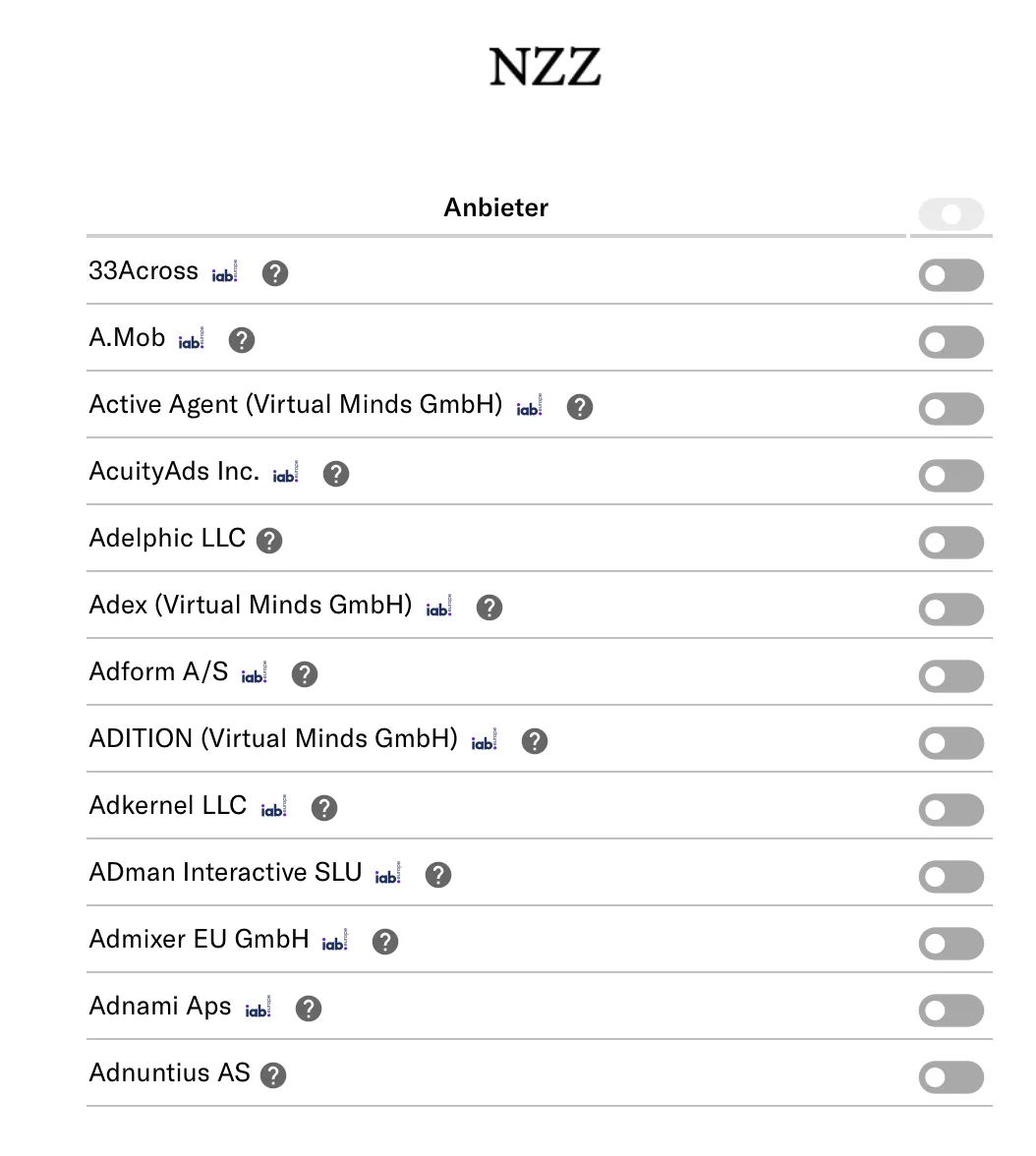
Has it really come to this? Do I have to show ID to buy a newspaper? Not yet – at least not in print. The example is fictional. Online, however, it is reality. If I want to read the article about e-ID in which the NZZ promises me digital paradise, I have to accept cookies.
Behind this are hundreds of advertisers and data companies worldwide, from the US to Israel. They want to know when I log in, from which IP address, perhaps how my mouse moves. They draw conclusions: What is this person’s daily routine? What content do they click on? This creates a movement and personality profile – the ‘data gold’ that everyone is after today. Ultimately, it ends up with corporations like Palantir or governments that can read everything.
Orwell is outdated
“Big Brother is watching you” is long outdated. Today, “Big Brother is everywhere.” He is there, even when you sleep, and can theoretically monitor your pulse, heartbeat, and sleep quality in real time; he extracts, combines, and merges data.
The right to human dignity states that human beings must not be turned into objects. In digital capitalism, however, human beings are primarily data carriers — walking mines from which gold is gradually extracted. Privacy is the soil in which human rights are rooted. Free development is only possible in unobserved spaces that belong to us alone. Those who feel they are being watched at all times are deprived of their right to authenticity. Then we have arrived at the human park, the petting zoo for humanoids, where governments and data pukers (sic!) like Palantir watch the digitally fenced-in humans live their lives.
RFID Chip war gestern, Mikro Chips seit 2014 gibts über Handschlag
Today, I already pay with data when I want to read an article. No one knows what happens to it later.
What if, in the future, I can only log in with my eID? The legal basis for this quasi-compulsion is already laid down in the law, Art. 25. The voluntary obligation only applies to public authorities. Switzerland has already rejected digital identity once. Now the proposal is being put to the people again. Once again, citizens are to decide whether they want to be put on a digital leash.
The promise: everything will be easier, more beautiful, more magical. Supposedly, everything is open source, decentralized, and economical on data — voluntary, of course. The reality: checkpoints are created, mistrust grows. To obtain the e-ID, you have to register with the Federal Police Fedpol and link the ID to your cell phone, which becomes a kind of key to the digital and probably also analog space. So it’s only a matter of time before media companies, web shops, and mobile phone providers turn “voluntariness” into an obligation.
What appeared to be voluntary quickly became and continues to become compulsory. No one has to use the eID. But then no one has to access a service that only works via the e-ID. At first, companies benefit, attracted by mountains of data. But the state has the upper hand: it observes, intercepts, and controls. In the end, both the state and the economy prey on citizens’ data.
Even the memory of the introduction of vaccination passports is eerie. With e-ID, populations can be further segmented. Digital mobility can also be used to control and regulate physical freedom of movement. Then it is no longer the primacy of freedom that applies, but the primacy of privileged access to freedom.
„Wir landen jetzt im digitalen Gefängnis“ - Punkt.PRERADOVIC mit Tom-Oliver Regenauer
The Swiss e-ID did not come out of nowhere. It is part of a global trend: WHO vaccination passports, international health regulations, restrictions on privacy, telecommunications secrecy, and freedom of residence. In the UK, it is called “oneID,” in Germany “digital wallet.” And Article 32 of Swiss law provides a loophole under international law that could be used to indirectly introduce an e-ID.

It seems orchestrated — and it is. The law has long been a done deal. The approval of the people is considered a formality. Politics here functions like a ratchet mechanism: always in one direction — more control, less freedom. Whether it happens faster or slower is not so important, as long as it moves forward.
There will be many more votes and legislative proposals in this direction. But it must be clear to everyone: digital self-empowerment means first and foremost to do without a control network that can lock you out at any time — like the computer HAL 9000 in 2001: A Space Odyssey: “Sorry, I can’t let you in anymore.”
Defending the right to analog life
A hundred years ago, it was possible to cross borders without a passport. Today, even traveling on the virtual highway is only possible after passing through a checkpoint. In the shadow of COVID-19, wars, and the authoritarian zeitgeist, a control system is emerging that could be described as turnkey totalitarianism. It is a system that can be activated at any time — in the name of protecting young people or ensuring security. The lock on the digital prison will click softly into place, accompanied by the rhetoric of pursuing the highest goals and best intentions. As always.
Thus, a tremendous asymmetry is revealed in “our democrature”: a few know everything about many. Conversely, there is no transparency. But freedom requires equal access to knowledge. This asymmetry of information shows that we are increasingly living in a human park, an open-air prison, mapped out, marked out, criss-crossed by checkpoints.
There is a right to life, to the free development of personality — even without digital representation. There is a right to be left alone. A right to be allowed to be a nobody. A right to move unmolested in both analog and virtual space.
Every movement generates a counter-movement. The tighter the boundaries of the digital world are drawn, the stronger the longing for analog free spaces grows — and with it, hopefully, the value of the right to an unsupervised, self-determined life. What will be the way out of the digital human park? Voluntarily moving to a self-built analog reserve?
On September 28, Swiss voters will have the opportunity to prevent the pawl, i.e., their digital thumb screw, from locking into place again.
Jean Claude Juncker „Wir beschließen etwas, “ 1999
ADVERTISEMENT:
Are you looking for the easiest way to buy and store Bitcoin yourself? The Relai appatuszek) is Europe’s most successful Bitcoin app. Hereatuszek) you can buy Bitcoin in just a few steps and also set up savings plans. No one has access to your Bitcoin except you. Relai is now lowering its fee to 1%, and with the referral code MILOSZ, you can save an additional 10%. (This is not financial advice). Disclaimer regarding EU Mica regulation: Relai’s services are recommended exclusively for residents of Switzerland and Italy.
THE FRIEDENSTAUBE ALSO FLIES INTO YOUR MAILBOX…
Here you can subscribe to the *Friedenstaube, the first uncensorable peace publication, and receive the articles in your mailbox, free of charge for everyone for the time being; we are starting without a paywall. (Paid subscriptions will only start once a monetization concept for the content is in place). **Would you like to support us with a voluntary subscription or become a publisher by joining the cooperative? More information (also for authors) here.*
The latest articles from Friedenstaube are now also available on our own Friedenstaube Telegram channel.
Can you and want to write? We are also looking for volunteers and interns (contact: friedenstaube@pareto.space).
The Pareto Project is becoming a cooperative! If you want to help build the future of uncensored journalism, you can find more information here.
A heartfelt thank you for supporting my work!
I can also set up manual access to the publication for you if you prefer to pay via PayPal, bank transfer, or Bitcoin (one-time annual fee, lifetime access). You can reach me at kontakt@idw-europe.org.