Review of: “Vereinnahmte Wissenschaft – Die Corona-Protokolle des Robert-Koch-Instituts” (Co-opted Science – The Corona Protocols of the Robert Koch Institute).
This article first appeared in German at Freischwebende Intelligenz. You can find all the articles by Free-floating Intelligence in English here – subscribe now, to get the articles by e-mail! This article has been written with the Pareto client.
Get the latest articles from Free-floating intelligence by subscribing to the newsletter.
Get the latest Pareto articles via Telegram.
There are books that you read — and books that read you. Vereinnahmte Wissenschaft (Co-opted Science) belongs to the second category. What editor Bastian Barucker has delivered here with a team of lawyers, epidemiologists, data analysts, and journalists is not yet another pandemic review with cotton wool padding, but a dissecting indictment of the confusion between science and will-making. The basis: the leaked minutes of the RKI crisis management team. The results: politics as director, science as statist.
The book’s greatest strength is that it does not rely on hindsight or snippets taken out of context, but rather on a systematic reading of the RKI protocols over time. As a reader, you sit at the crisis table, so to speak, and hear how assessments are overturned, formulations tightened, and terms adjusted — often without a reliable data basis, but with a lot of political momentum. The famous “upgrading” of the risk in March 2020 is symbolic here: while serious voices urge caution and data quality, the narrative of utility prevails because it legitimizes measures. The book does not claim to possess the one truth; it shows how truth was made.
One chapter that leaves a lasting impression is the mask chronicle. Not because it was unexpected, but because it suddenly becomes factual in the protocol lines: the authors trace how the RKI was aware of the lack of evidence — and yet the obligation came. Not as a gentle recommendation, not as a situational instrument, but as a psychopolitical symbol. The contributions by Oliver Hirsch and Kai Kisielinski read like what should have long since taken place in an educated public: definition of the target effect, examination of the evidence, consideration of the side effects (children, vulnerable groups, misuse). Instead: the moral imperative that replaces science. Anyone who disagreed was not a counterargument, but a threat.
The book deals with the vaccination campaign with similar precision. The key point is not a post-factual “would have, could have” — the key point is internal doubts that appear in the protocol and are then politically overridden. Alexander Konietzky and Sabine C. Stebel reconstruct how hope initially turns into rhetoric of promise and ultimately into an agenda: rapid vaccination coverage, communication without the subjunctive, minimized uncertainties. The work does not question the protective effect that did or did not exist; it shows how the administration of truth worked — and that children were treated with a sobriety that should actually set off alarm bells in a free society.
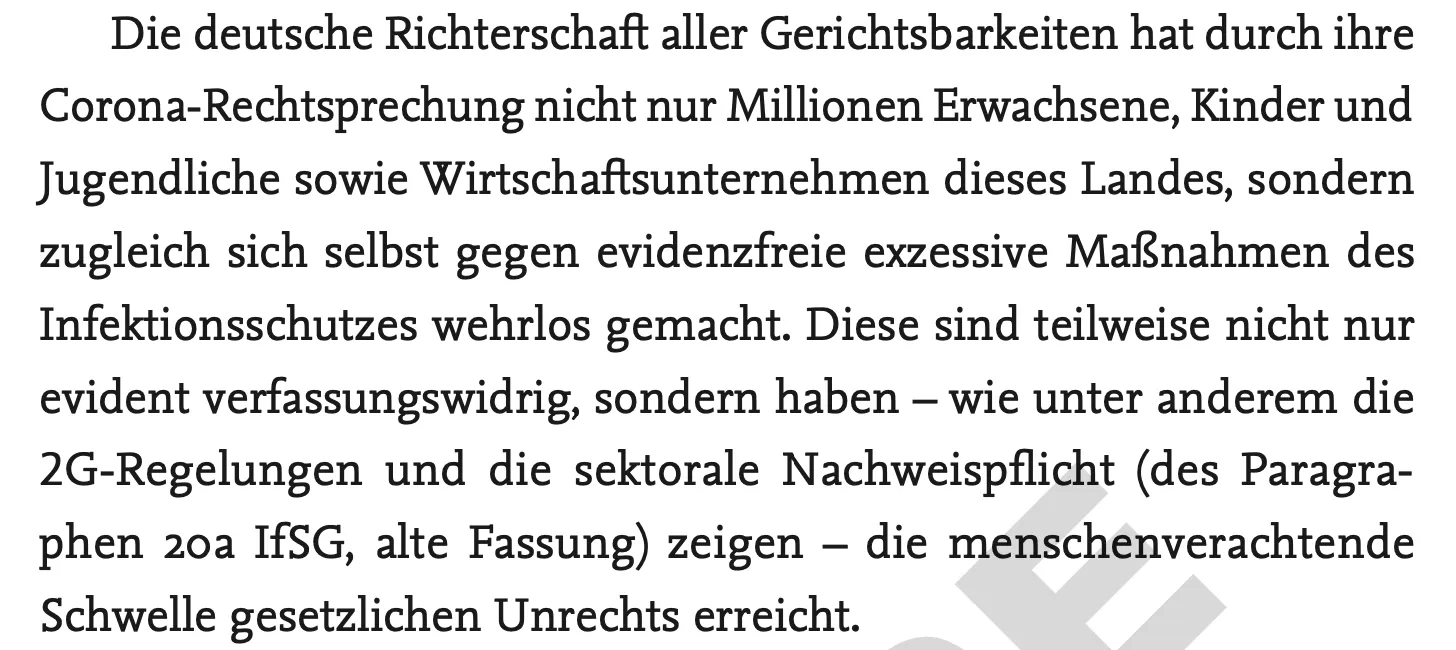
Perhaps the sharpest blade in the book is where it touches on the separation of powers. Volker Boehme-Neßler and Sebastian Lucenti write about courts that ruled in favor of authority in a series of cases. Instead of evidence: a reference — to the RKI, whose independence can no longer be treated as sacrosanct, now that the protocols are in hand. The Osnabrück Administrative Court, which questioned RKI President Lars Schaade, marks a legal turning point here. Those who restrict fundamental rights must provide evidence. It is not the citizens who bear the burden of proof for their freedom, but the state that bears the burden of proof for its interventions. The book reminds us of this inverted burden of proof with the clarity of a slap in the face.
And the media? Ruth Schneeberger and Frauke Rostalski write what many feel: the fourth estate has often played along, if not in the choreography, then at least in the applause. The defamation of critical voices, the dismissal of open questions as “disinformation,” the confusion of attitude with research — all of this is presented here not in a rage, but in a documented manner. The result is not a reckoning with journalists, but an invitation to take their profession literally again.
Formally, the book is pleasantly polyphonic: it consists of carefully edited individual contributions that support each other. No echo chamber, but a chorus of reasons. In terms of content, it oscillates between archival work ( protocol passages, chronicles), analysis (evidence, methodology), and norms (law, proportionality). Those who crave bold final judgments will be disappointed; those who seek dense argumentation will be rewarded.
Sometimes one wishes for even more primary documents in facsimile, even harder tables on side effects, and clear counterfactuals (“What if we hadn’t done X?”). But these wishes are luxury problems. The crucial thing is that Vereinnahmte Wissenschaft (Co-opted Science) fulfills a public duty that politicians and the mainstream media have refused to do: reconstruct, examine, doubt — without infantilizing the citizenry.
One sentence sticks in mind after reading: Science is method, not power. Those who confuse the two produce obedience, not health. Vereinnahmte Wissenschaft (Co-opted Science) is therefore not a “pandemic book,” but a democracy book—one that will still be read in ten years’ time, when the next state of emergency calls for scientific uniformity. It is uncomfortable because it educates. It is necessary because it reconciles, not by coddling, but by cultivating truth.
Recommendation? Definitely a must-read. Not to settle old scores, but to avoid new mistakes. This book belongs on the desks of parliamentarians, editors, judges — and in the hands of those who are no longer willing to delegate their adulthood to the executive branch. Anyone who takes democracy seriously must learn to live with uncertainty — and with contradiction. Vereinnahmte Wissenschaft (Co-opted Science) shows how to organize both in a civilized manner: with open protocols, tough questions, and the refusal to accept hypermorality and hygienic sadism as evidence during the coronavirus pandemic.
When will those responsible be held accountable?
Bastian Barucker (Herausgeber): Vereinnahmte Wissenschaft – Die Corona-Protokolle des Robert-Koch-Instituts. Massel Verlag, München, 2025, Umfang: 252 Seiten, Softcover mit Klappen.ISBN: 978-3-948576-21-9, Preis: 22,90 EUR.
Order from the publisher:
Massel Verlag – Book page: https://www.masselverlag.de/Programm/Vereinnahmte-Wissenschaft/
ADVERTISEMENT:
RELAI is now available in the whole European Union! Are you looking for the easiest way to buy and store Bitcoin yourself? The Relai appatuszek) is Europe’s most successful Bitcoin app. Hereatuszek) you can buy Bitcoin in just a few steps and also set up savings plans. No one has access to your Bitcoin except you. Relai is now lowering its fee to 1%, and with the referral code MILOSZ, you can save an additional 10%. (This is not financial advice).
THE FRIEDENSTAUBE ALSO FLIES INTO YOUR MAILBOX…
Here you can subscribe to the *Friedenstaube, the first uncensorable peace publication, and receive the articles in your mailbox, free of charge for everyone for the time being; we are starting without a paywall. (Paid subscriptions will only start once a monetization concept for the content is in place). **Would you like to support us with a voluntary subscription or become a publisher by joining the cooperative? More information (also for authors) here.*
The latest articles from Friedenstaube are now also available on our own Friedenstaube Telegram channel.
Can you and want to write? We are also looking for volunteers and interns (contact: friedenstaube@pareto.space).
The Pareto Project is becoming a cooperative! If you want to help build the future of uncensored journalism, you can find more information here.
A heartfelt thank you for supporting my work!
I can also set up manual access to the publication for you if you prefer to pay via PayPal, bank transfer, or Bitcoin (one-time annual fee, lifetime access). You can reach me at kontakt@idw-europe.org.