Former Swiss General Staff officer Ralph Bosshard on neutrality, intelligence services, STAY-BEHIND structures, his experience with the OSCE and Western special forces in the war in Ukraine
Switzerland is facing a fundamental foreign-policy debate. On one side are those who want to preserve the country’s traditional neutrality. On the other, political and military alignment with the EU and NATO is increasing.
Behind this visible debate, however, Ralph Bosshard suspects a deeper conflict.
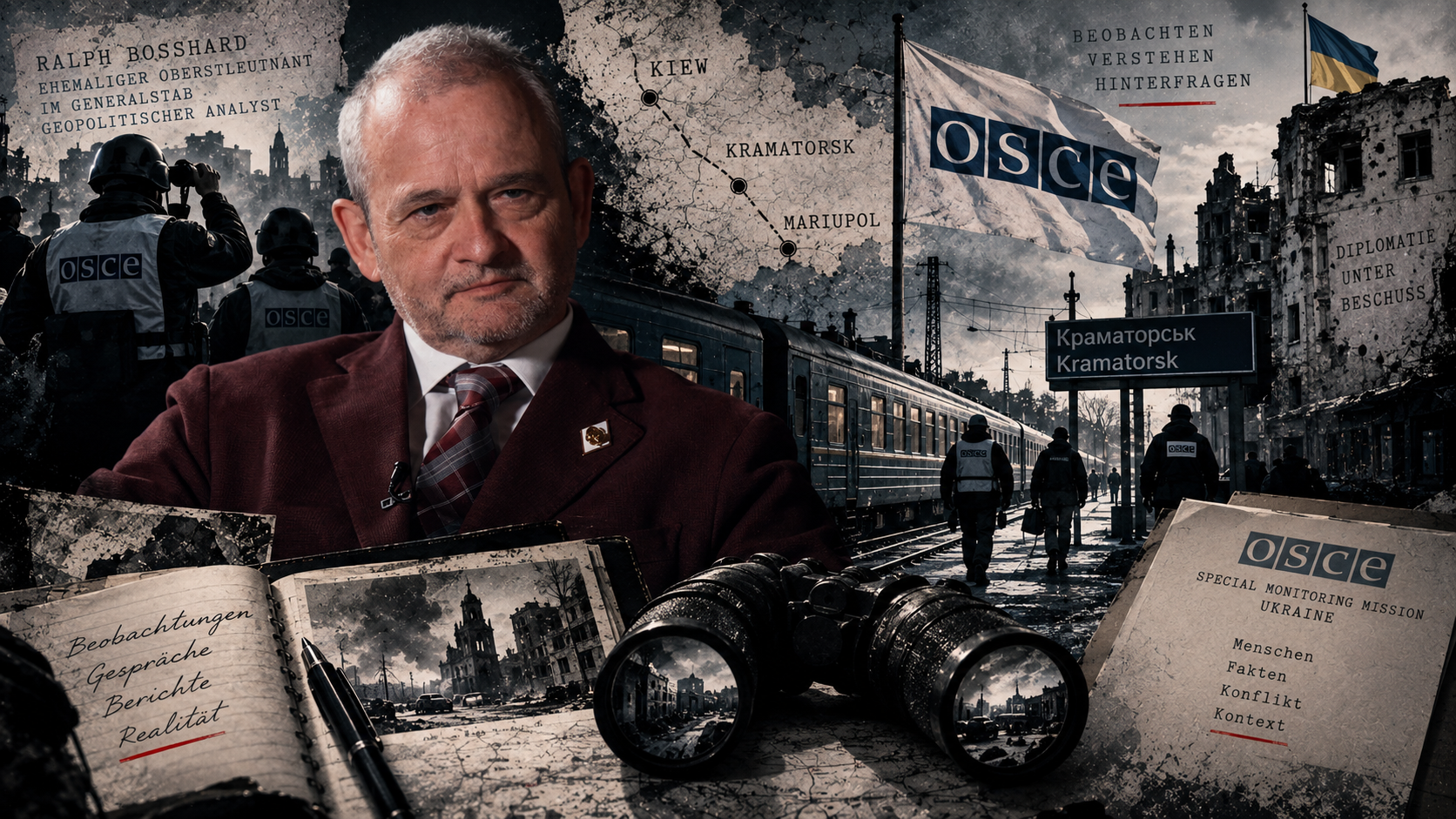
Ralph Bosshard was a lieutenant colonel on the General Staff of the Swiss Armed Forces, completed both Swiss and Russian general staff training and worked for a time in the OSCE environment. Today he works as a geopolitical analyst.
The conversation therefore concerns more than Swiss neutrality. It is about intelligence services, covert networks and structures of the secret NATO-Army STAY-BEHIND, Bosshard’s experiences during his time with the OSCE, and the question of what role Western special forces play in the war in Ukraine.
Bosshard repeatedly distinguishes between what he personally observed or experienced, what he derives from his military experience, and what he merely suspects.
The conversation thus enters an area of war that is, by its nature, difficult to verify: the shadow war of intelligence services and special forces behind the visible front.
“The Swiss People Deserve a More Factual Discussion”
Patrik Baab: Lieutenant Colonel, you wrote the book “Wehrhaft neutral”. What do you want to achieve with it?
Ralph Bosshard: I want to make the discussion about neutrality in particular, and Swiss foreign policy in general, more factual, because at present we are experiencing a mixture of refusal to engage in discussion on the one hand and cheap slogans, I would even say propaganda slogans, with very little sense on the other.
There are people who say this is a Blocher initiative. Former Federal Councillor and strongman of the Swiss People’s Party Christoph Blocher is said to have initiated it. Others say it is a pro-Putin initiative.
I think the Swiss people currently deserve a more factual discussion about the direction of Swiss foreign policy over the coming years and decades, because we are now in a phase in which the global balance of power has begun to shift.
There has to be more substance behind it than anti-Putin and anti-Trump propaganda. And I hoped I could contribute something to that.
Patrik Baab: Are the supporters of neutrality in Switzerland doing Putin’s business?
Ralph Bosshard: No, I would reject that theory.
Of course, throughout history the great powers have always adjusted to the fact that Switzerland is neutral and remains neutral.
We must also be clear that Switzerland entering the war on Ukraine’s side against Russia would not change the balance of forces, above all not the military balance, but neither the political nor economic balance, and it would no longer influence the course of this war.
“There Is a Shadow War on Swiss Soil”
Patrik Baab: Swiss neutrality is a result of the Congress of Vienna of 1815. But today in particular it is under special pressure. Are there NATO networks in Switzerland?
Ralph Bosshard: Yes, of course there are.
Swiss military personnel have been influenced for decades, among other things through training courses they completed at NATO academies.
But we also know that operations were carried out with the aim of removing unwanted diplomats and military officers from their posts.
We also know with certainty that Ukrainian intelligence services are behind this.
For example, in the case of a colonel who was falsely accused of treason, we know that an employee of the Ukrainian intelligence service, Alexander Daniliuk, was behind it. I have seen the investigation files myself.
We also know of other activities by Ukrainian intelligence services in Switzerland.
There is a Ukrainian journalist here in the canton of St Gallen whose house was attacked by arson. About a year ago, an assassination attempt was made on him at the Swiss-Austrian border.
These are not fanatics from the Ukrainian diaspora here in Switzerland. These are hired killers.
The attacker was carrying a silenced pistol. That is not something one can simply obtain here in Switzerland if one has become politically unhinged and believes opposition has to be eliminated in this way.
Patrik Baab: That means Switzerland is being drawn ever deeper into the war in Ukraine. There is a shadow war on Swiss soil.
Ralph Bosshard: That is the case.
The Swiss authorities now have to look very closely to ensure that this shadow war does not at some point turn into, for example, a gang war.
Patrik Baab: Are Ukrainian intelligence services on Swiss soil already using such gangs with the tacit backing of politicians?
Ralph Bosshard: I would not go that far.
At the moment, the problem seems rather to be that public prosecutors and police forces in Switzerland are not yet able to deal with this form of organised crime.
There is certainly also a lack of specialist knowledge about organised crime from the former Soviet Union. There is certainly a lack of language skills.
What is probably also still lacking is an understanding of the extreme degree of violence these people are capable of.
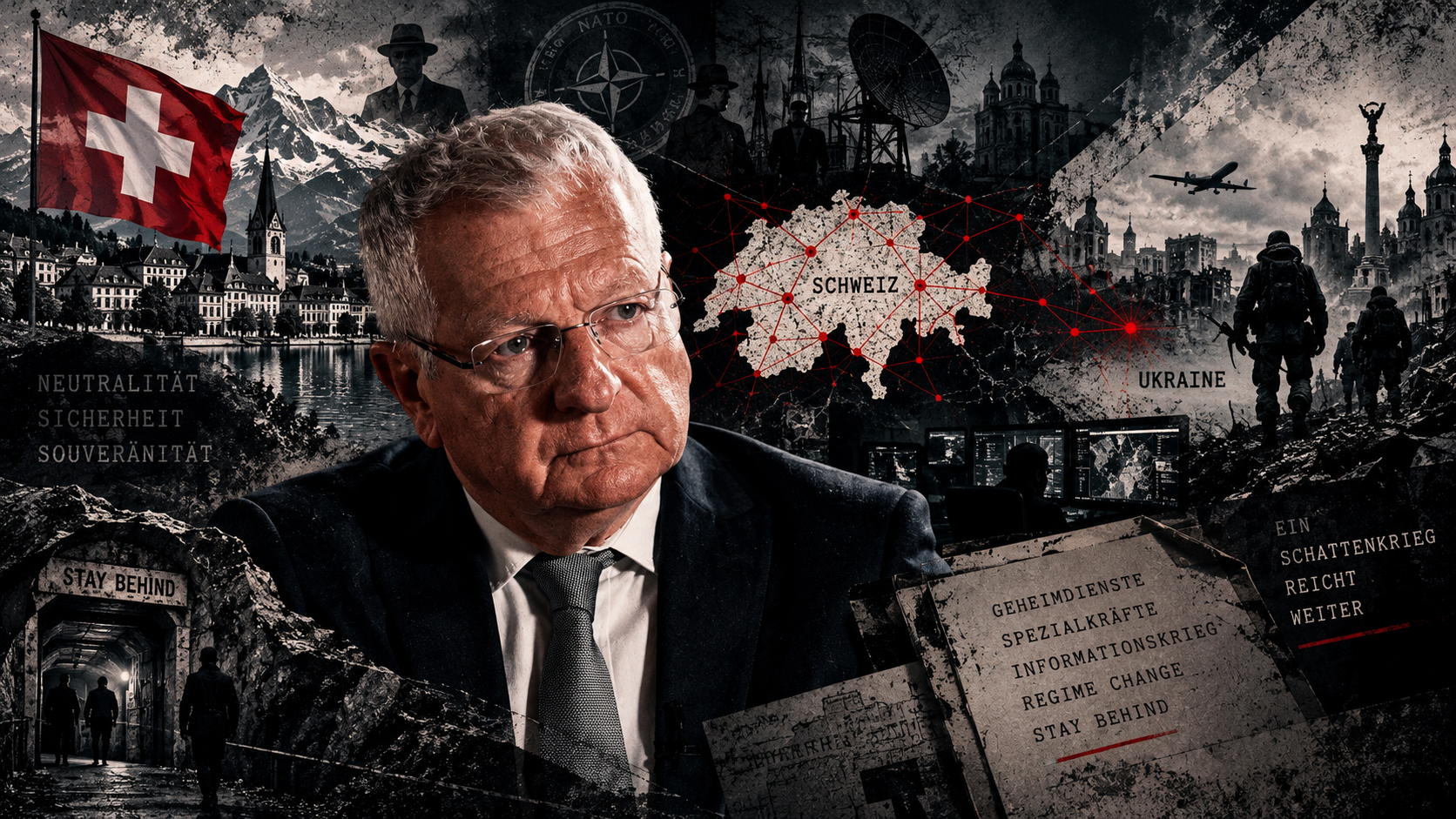
Are New STAY-BEHIND Structures Being Created?
Patrik Baab: During the Cold War there was a NATO secret army, STAY-BEHIND or Gladio in Italy. The aim was to wage guerrilla warfare behind enemy lines in the event of a Russian invasion. But the aim was also to act internally and to obstruct or even eliminate all forces opposing American dominance in Europe. Are there still STAY-BEHIND activities in Switzerland today?
Ralph Bosshard: From my time in operational planning on the command staff, I would not be aware of anything like that.
But as you mentioned, these STAY-BEHIND organisations were also set up with a view to their internal effect.
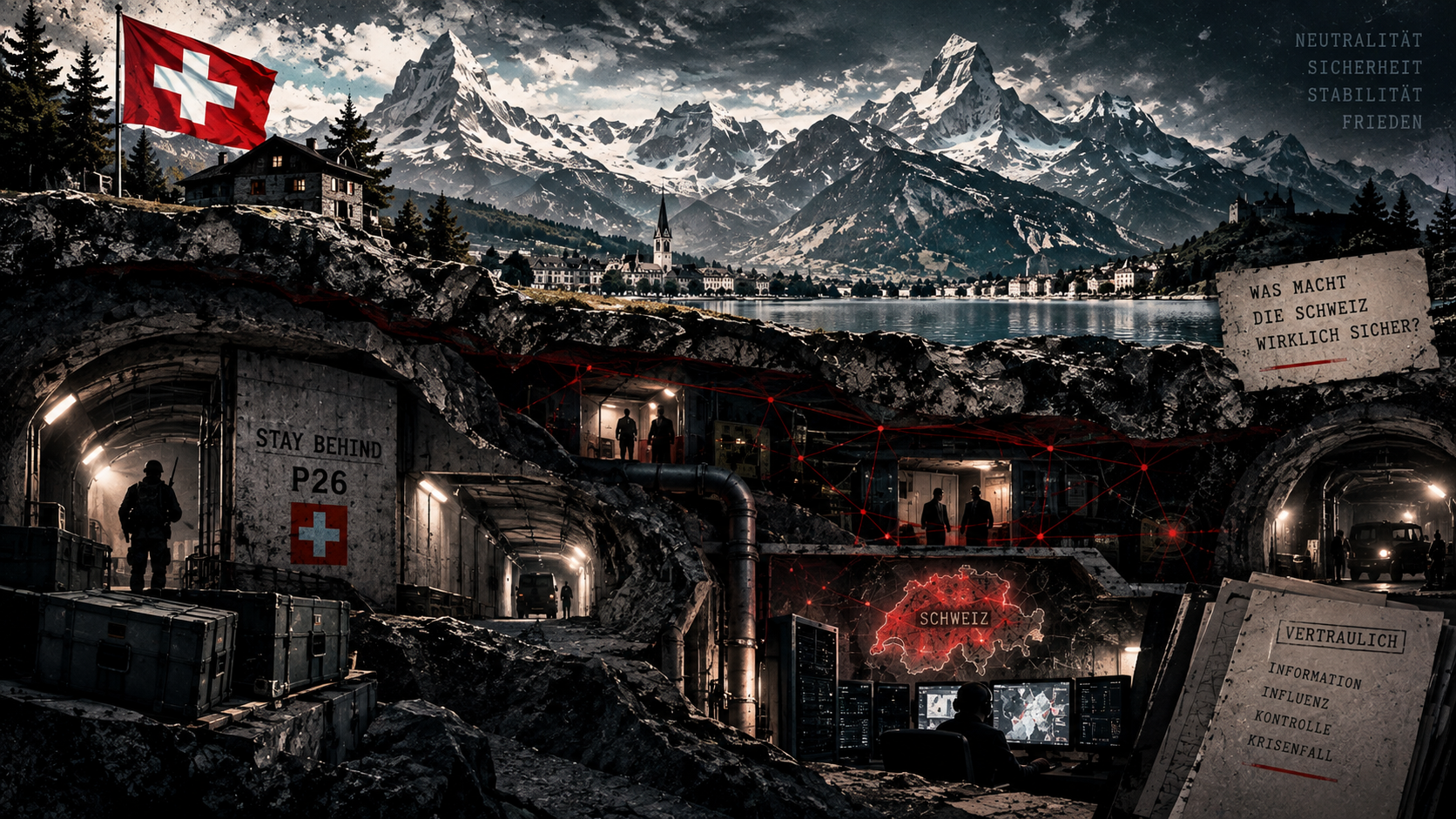
In Switzerland we had the P26 organisation, which was conceived as a STAY-BEHIND organisation. The idea at the time was that such an organisation could have a certain deterrent effect by showing the Soviets that they would have difficulty controlling Switzerland, its territory and its population if they invaded.
The entanglement of NATO intelligence services and the involvement of Ukrainian intelligence services naturally fuel the suspicion that structures are now being built here in Switzerland that may ensure that Switzerland and its population remain under control as well.
I would not rule that out.
The Leipzig Drone and the Question of a False Flag
Patrik Baab: We have a drone found at Leipzig Airport, loaded with explosives. According to his own account, a bus driver disabled it with a kick. Ukrainian Antonov transport aircraft were nearby. How do you assess this incident? Who had a hand in it?
Ralph Bosshard: There is, of course, speculation about a possible Ukrainian false-flag operation.
What I see is that, in connection with hesitant attempts by circles close to the German government to establish contact with Russian officials, which does not take place directly, Baku in Azerbaijan is one such station, Swiss diplomats have also been involved.
One possible aim could be to prevent German-Russian talks from taking place at all. Hardliners from Ukraine in particular could have an interest in that.
Patrik Baab: The German government accuses Moscow of being behind this drone incident, refers to intelligence information, but presents no evidence. How do you assess that?
Ralph Bosshard: The German government does not know what it wants.
If it really wants this incident to be fully investigated and someone to be brought before a court and convicted, then it is legitimate to keep certain investigative findings secret.
But if it wants to extract political capital from the incident, then in my view it would have to put all the information it has on the table.
And there are inconsistencies.
The explosive Semtex is not a Russian explosive. It was originally manufactured in what was then Czechoslovakia. With the marker substances for explosives that must now be added under international agreements, it should actually also be possible to identify the manufacturer of the explosive.
The German government has so far refrained from doing so.
There is still too much about this story that is unclear and imprecise for one, in my view, to build a huge political scandal out of it now.
Maidan: “I Strongly Suspect It”
Patrik Baab: Did Western intelligence services have a hand in organising demonstrations on the Maidan?
Ralph Bosshard: I know from participants in those demonstrations that they were paid. 250 to 300 hryvnia per day was the standard rate at the time.
With enough money, you can bring a sufficiently large crowd onto a square.
I am fairly certain that an ambassador knew a demonstration could become violent at any time. Their security was assessed. Intelligence officers were on the square. I cannot imagine anything else.
And I once personally encountered Geoffrey Pyatt, the then US ambassador in Kyiv. I have absolutely no doubt that he poured a great deal of oil on the fire in a situation in which, of course, there was a certain dissatisfaction with the Yanukovych government.
Patrik Baab: The protests on the Maidan ended in bloodshed. Almost 100 people were killed. How did Georgian snipers get there? With the help of Western intelligence services?
Ralph Bosshard: I strongly suspect it.
Western intelligence services certainly knew about it. How much they promoted it, how much they had to promote it, I cannot say.
What Ralph Bosshard Personally Observed with the OSCE
Patrik Baab: According to your account, the suppression of the protests in eastern Ukraine was supported very quickly by Western services. What do you know about that?
Ralph Bosshard: At the OSCE, in the mission in Kyiv, we knew at the time that one floor of the SBU’s main building in central Kyiv had effectively been reserved for the Americans.
Then, on a trip to Mariupol, on the train between Kyiv and Kramatorsk, I observed very conspicuous Americans who were received by military personnel in Kramatorsk.
At the time, we assumed they had to be employees of American intelligence services.
We also knew in the Special Monitoring Mission team (SSM) in Mariupol at the time that Western intelligence services were active, including in the city.
I therefore assume that Western intelligence services and Western special operations forces were already active in Ukraine in autumn 2014.
Patrik Baab: Did they organise the suppression of the uprising in eastern Ukraine?
Ralph Bosshard: Certainly supported it massively.
Today I am certain that Geoffrey Pyatt, whom I mentioned, promised the then interim president Turchynov that the United States would actively support him in suppressing the uprising in eastern Ukraine.
Patrik Baab: Did the Americans try to instrumentalise the OSCE monitoring mission?
Ralph Bosshard: Not only the Americans.
We were of course aware that all of our observers occasionally owed reports to their foreign ministries and also to their intelligence services about what they had observed there.
The Special Monitoring Mission was actually established so that the OSCE would receive genuinely independent information from the crisis area.
But in fact a great many intelligence officers were active in this mission, including Ukrainians among the locally employed staff.
It did not even require much American personnel. NATO and the Americans probably obtained the information mainly from the local employees.
But yes, the mission was intended to be instrumentalised.
CIA Stations and STAY-BEHIND
Patrik Baab: According to the New York Times, the CIA very quickly managed to build twelve secret stations in eastern Ukraine. What were they doing there?
Ralph Bosshard: I assume that the Azovstal site in Mariupol in particular was used for electronic reconnaissance towards southern Russia.
It is ideally situated, close to the border and in a large industrial complex.
I assume that such listening stations were also established in Sumy.
This may be military electronic reconnaissance. But it may also be electronic reconnaissance by US intelligence services, which for purely physical reasons must of course do everything they can to move listening stations as close to the Russian border as security permits.
I also think these stations will have been used to determine whether there are possibilities to infiltrate Russia, to exfiltrate from Russia again, whether there are possibilities to recruit agents inside Russia and build an agent network.
Patrik Baab: From the end of 2014, did the twelve CIA stations in eastern Ukraine work on building a secret army, a STAY-BEHIND organisation, in case of an expected Russian invasion?
Ralph Bosshard: Certainly.
I know from employees of the Austrian Armed Forces that the Americans in particular advised the Ukrainians to implement something like Austria’s Spannocchi doctrine from the Cold War.
The intelligence services of NATO states and also of the United States then went one step further and built an underground organisation.
Not merely tried to build one, but built one.
I assume, however, that it too has since been broken up and worn down.
“Anything Else Would Surprise Me”
Patrik Baab: Are Western special forces also active today, for example in Kharkiv, Kyiv or Odesa?
Ralph Bosshard: Anything else would surprise me.
The special operations forces of NATO states will of course support the Ukrainians to the best of their ability.
They are actually the only forces Western governments can make available to Ukraine without having to answer for it to parliament and the public.
On the other hand, these people will seek to benefit from Ukrainian experience. They will want to gain experience themselves. They will contribute specialised know-how.
I think, for example, that special forces of the British Royal Navy and also the Royal Marines operate from Odesa, from the port of Odesa, against the western coast of Crimea, because they simply have experience and know-how in this field, which they naturally pass on to the Ukrainians.
Patrik Baab: Was a British unit involved, for example, in attacking and sinking the Moskva?
Ralph Bosshard: Of course I cannot prove it.
But if there is a British unit suited to it, then it is precisely the Special Boat Service SBS.
The French have similar formations, Germany has similar formations. Those are exactly the troops one has to use for this. And I have no doubt that governments are engaging in this game.
The Kerch Bridge
Patrik Baab: What role did the SBS play in the attack on the Kerch Bridge?
Ralph Bosshard: I could imagine that reconnaissance, planning, target surveillance and possibly also battle-damage assessment were supported to a considerable extent by the British.
You cannot simply fire a stand-off weapon of any type, a cruise missile or a ballistic missile, at such an object blindly, without knowing what is going on there and what defensive measures are installed.
And afterwards you will want to know exactly what was destroyed.
I assume that Ukrainian and NATO special operations forces were somewhere in the waters around Kerch at the time of impact, observing it, and that they had already monitored the object for days and helped with the planning.
Patrik Baab: What role did British forces play on the ground?
Ralph Bosshard: I think the British certainly helped with the planning. It always has to be coordinated with the other operations.
But as usual, of course, we left the execution to the Ukrainians.
German Soldiers in Ukraine?
Patrik Baab: Are Bundeswehr special forces also involved in this shadow war on Ukrainian soil?
Ralph Bosshard: I could imagine that.
The German government’s efforts after 2014 to station German soldiers in Ukraine by some means were extremely conspicuous.
In autumn 2014 we negotiated the use of drones in the OSCE to monitor the ceasefire, and the German government offered the Luna drone.
We fairly quickly concluded that the Luna drone was not the most suitable equipment for our purposes.
But what struck me was this: they immediately tried to station an entire Bundeswehr battalion behind these few Luna drones and their few operators.
They said it could not be done without a security company, that a light infantry or paratrooper company had to come along, that a German field kitchen had to come along, that a German military hospital had to come along.
In the end we were at battalion strength.
Even then I began to suspect that this was not so much about the drones, which were not particularly suitable, but simply about stationing German soldiers in Ukraine.
How Directly Is the West Involved in Long-Range Attacks?
Patrik Baab: Since early summer 2026, Ukrainian forces have been conducting a drone and long-range weapons campaign against targets in the Russian rear. What role do Western intelligence services and special forces play in this?
Ralph Bosshard: They certainly play a role, because the Ukrainians do not have the capabilities for target reconnaissance, monitoring certain targets, transmitting data to that depth, or battle-damage assessment.
Until now, the United States had to provide that to them.
They probably still provide it to a limited extent. But of course Western European governments must also, or primarily, provide it to them.
Otherwise the Ukrainians cannot make it work. Moscow knows that too.
Patrik Baab: Are the Ukrainians merely dependent on data transmission from Western reconnaissance forces and intelligence services, or are Western personnel standing alongside the launch batteries for drones and guided missiles, with the Ukrainians only pressing the button?
Ralph Bosshard: Certainly.
These are such complex systems that they cannot function without maintenance services, servicing, but also services in planning and preparation.
Experienced personnel with the technical knowledge have to be there.
Where Does This War End?
Patrik Baab: We have a situation in which neither side wants to retreat and neither side can retreat. Moscow sees this as an existential conflict. The West has pumped so much money into Ukraine that withdrawal is becoming politically more and more difficult. Where will this end?
Ralph Bosshard: It could end in a long low-intensity war along the new border.
I think Ukraine will now try to threaten Russia with just such a prolonged low-intensity drone war.
After 2014, the West knowingly accepted the risk of a conflict. I said this quite openly to the German Bundestag in summer 2023, in the Reichstag building.
And now one has to realise that one played with fire without knowing exactly what one was getting into.
In October 2023 one had to acknowledge, with some consternation, that one was not as militarily superior as one had believed, that one could not help Ukraine reconquer the lost territories.
But at the moment no face-saving way out can be found.
I know that circles close to the government in Berlin are asking themselves: How do we get out of this conflict again without losing face?
I would actually expect rapid improvement only if some of the protagonists in Brussels, Berlin, Paris and/or London eventually have to vacate their seats and make way for people who have invested less prestige and can go further with concessions to Russia than those currently in power.
Patrik Baab: I repeatedly hear from different circles among the parties to the conflict: without a change of elites in the West, no peace will be found in Ukraine. Would you agree?
Ralph Bosshard: I fear that is the case.
Large parts of the elites, including the press and media landscape, have invested so much at the moment, have positioned themselves so decisively on Ukraine’s side, that they would lose face if they suddenly applauded a peaceful solution.
I already see a certain discrepancy between media reporting and the assessments of the intelligence services today.
And at some point these intelligence services will really be able to convey the unvarnished truth to their governments.
Then large parts of the elites, the press and the media will be very consternated.
Conclusion
The conversation begins with Swiss neutrality and ends with the question of how a way out of the war in Ukraine can still be found. In between lies what Ralph Bosshard describes as a “shadow war”: intelligence services, special forces and operations about which little is publicly known. How far this covert war actually extends remains one of the open questions of the conflict.