Power hides inside coordination.
It appears when a family can finance a business before a bank understands it. It appears when a community finds housing and employment for a new arrival, when a professional network directs opportunity toward its members, or when an institution continues educating children long after its founders are gone.
These advantages are not contained in a bank balance. They emerge from the ability to remember, trust, organize and act across generations.
Money can preserve the fruits of coordination. It cannot create the whole structure by itself.
Bitcoin is beginning to encounter this distinction.
It has created a monetary network without a central issuer. It has gathered people across national, religious and cultural boundaries around a shared rule. It has established a form of property that can move globally without depending on the permission of any single political authority.
That is stateless money.
It is not yet a stateless commonwealth.
A commonwealth requires more than an asset and more than a protocol. It requires institutions that can educate, employ, finance, protect, represent and reproduce a community across generations.
BIP-110 matters because it exposes the distance between these achievements.
It begins as a dispute over Bitcoin’s technical boundaries. It leads toward a larger question of collective purpose. Bitcoin has demonstrated that monetary rules can survive without a ruler. The next challenge is whether people living under those rules can build durable power without recreating the concentration, corruption and mythology they sought to escape.
What a technical dispute reveals
BIP-110 appears to concern blockspace, arbitrary data and the proper use of Bitcoin’s consensus rules.
Those questions are real. A monetary network must consider which activities belong within the protocol, which costs node operators should bear and whether every technically valid use serves Bitcoin’s larger purpose.
The dispute becomes political because the protocol cannot interpret its own purpose.
Developers can propose rules. Miners can signal support. Node operators can choose which software to run. Businesses can decide which network they recognize. Holders can organize, buy, sell or remain indifferent.
No participant possesses complete authority. Their actions still combine to determine what Bitcoin becomes.
Consensus is therefore not the absence of governance. It is a form of governance in which authority is fragmented and unilateral change is deliberately difficult.
This makes Bitcoin unusually resistant to capture. It does not make Bitcoin free from politics.
BIP-110 reveals a community trying to define the boundaries of its shared institution. The disagreement concerns data, but it also concerns legitimacy, purpose and the limits of neutrality.
The proposal may succeed, fail or be forgotten. The institutional problem it exposes will remain.
Bitcoin has already learned how to defend a monetary rule.
It has not yet learned how to build a society around one.
Power is the ability to coordinate
Modern society describes itself through the language of individuals.
People are expected to build careers, manage finances, develop opinions and compete in markets as autonomous actors. Success appears to belong to the person who works hardest, thinks most clearly or accepts the greatest risk.
The most powerful groups rarely behave this way.
Families pool capital. Investors syndicate. Corporations lobby. Universities reproduce professional networks. Nations protect strategic industries. Religious communities transmit identity, duty and social support across centuries.
The public language is often individual achievement. The private practice is collective coordination.
This creates a hidden inequality.
A person with access to family capital can take risks that appear impossible to someone financing every failure alone. A graduate connected to a professional network receives information and introductions that never enter the public job market. A business supported by a community can survive long enough to become competent, while an isolated founder may be forced to close after one difficult year.
The difference may be interpreted as talent. Much of it is infrastructure.
Crossing the boundaries of class, religion, nationality or tribe makes this infrastructure easier to see. Belonging carries benefits that are rarely written down. It provides informal credit, trusted information, reputational shortcuts, fallback housing and people who have some obligation to care whether one succeeds.
The loss of that infrastructure can feel like a loss of personal ability.
It is often a loss of collective leverage.
Ibn Khaldun described this force through the concept of ʿasabiyyah, commonly translated as group solidarity.
In The Muqaddimah, he observed that materially poorer groups could defeat larger and wealthier societies when they possessed stronger cohesion. Their advantage came from shared hardship, mutual dependence and the ability to act with common purpose.
Solidarity transformed many limited individuals into one consequential political force.
Khaldun also understood that solidarity decays.
The generation that creates power remembers deprivation and sacrifice. The generation that inherits power often receives its benefits without acquiring the discipline that produced them. Shared obligation gradually becomes private entitlement. Institutions remain, but the social force beneath them weakens.
This pattern appears in families, companies, nations and religious movements.
It will appear in Bitcoin.
Bitcoin already possesses a form of ʿasabiyyah. It has a shared vocabulary, historical memory, recurring rituals, recognizable symbols, heroes, villains and an account of monetary corruption. Its participants have endured political hostility, financial collapses, exchange failures, internal schisms and repeated declarations that the experiment was dead.
Hardship has created loyalty.
Loyalty is not yet productive capacity.
A movement can agree about its enemies while remaining incapable of educating children, supporting families, operating businesses, resolving disputes or governing shared institutions. It can defend a protocol while failing to create a life that ordinary people would choose to inhabit.
Bitcoin’s defensive solidarity has been demonstrated repeatedly.
Its creative solidarity remains largely untested.
Money stores power but does not create all of it
Money carries claims through time.
A person holding money possesses a claim on labour, energy, land, goods and future production. The strength of that claim depends on a surrounding order that recognizes ownership, protects exchange and gives people confidence that the claim will remain meaningful.
Money therefore expresses power. It does not contain the whole of power.
Michael Mann’s The Sources of Social Power describes four broad networks through which societies organize power: ideological, economic, political and military.
Bitcoin is already strong in two of them.
It has substantial ideological power. It has changed how millions of people understand scarcity, savings, inflation, debt and central banking. It gives people a coherent explanation for experiences that once appeared unrelated, including rising asset prices, declining purchasing power and the political allocation of credit.
Bitcoin also has growing economic power. It stores significant wealth, settles value globally, finances companies, rewards energy production and increasingly appears on institutional and sovereign balance sheets.
Its political power remains fragmented. Bitcoiners can influence policy in some jurisdictions, but the movement has limited capacity to coordinate sustained legal defence, education, diplomatic relationships or long-term public institutions.
Its relationship to physical and military power is indirect. Bitcoin has no army, nor should it aspire to become an empire. Its users still live within the physical world. Mining facilities depend on energy, land, telecommunications and security. Property must be defended against theft and coercion. Infrastructure does not protect itself merely because ownership can be proven cryptographically.
The protocol can determine which private key controls a coin.
It cannot guarantee that the holder will remain physically free to use it.
Bitcoin does not escape the traditional forms of power. It changes the relationship among them.
This is why the separation of money and state should be understood as a constitutional limit rather than the disappearance of politics.
Bitcoin removes monetary issuance from ordinary political discretion. A legislature can regulate exchanges, impose taxes, restrict mining or prosecute individuals. It cannot simply create another ten million bitcoin while remaining compatible with the existing network.
This is a profound limitation on authority.
It does not answer how property will be protected, how fraud will be addressed, how families will survive emergencies, how infrastructure will be financed or how communities will resolve conflict.
Bitcoin constrains one of the state’s most powerful instruments.
It does not eliminate the responsibility to govern everything surrounding that instrument.
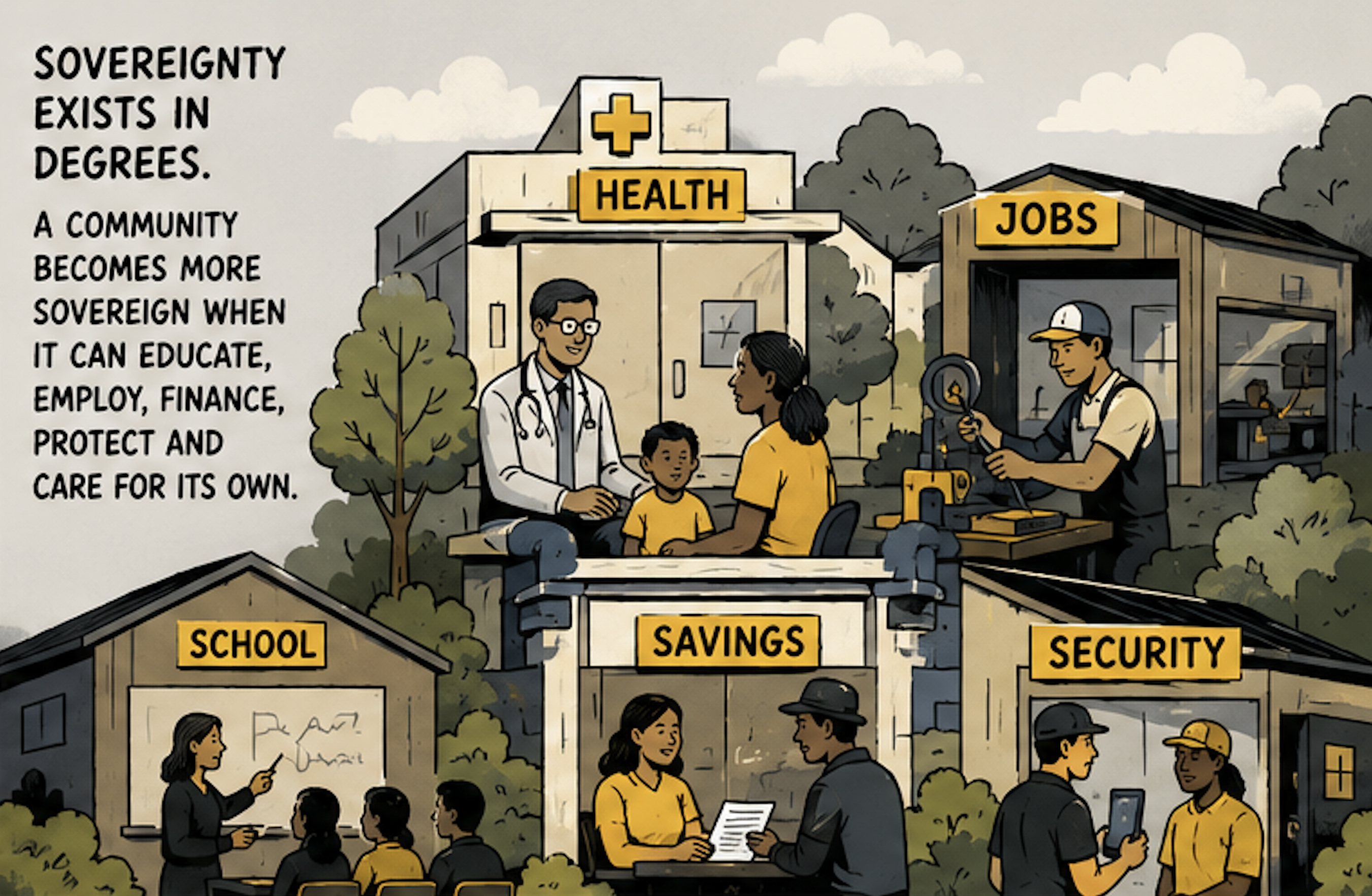
Stateless does not mean powerless
The modern imagination treats sovereignty as something that belongs almost exclusively to territorial states.
A state issues passports, controls borders, collects taxes, enforces law and claims a monopoly over legitimate force. A group without these powers appears politically incomplete.
Sovereignty, however, exists in degrees.
A community possesses a form of functional sovereignty when it can educate its children, finance its enterprises, care for vulnerable members, preserve its culture, represent its interests and reproduce itself across generations.
It may remain subject to the laws of several states. It may possess no army, currency or internationally recognized territory. It nevertheless retains capabilities that prevent its members from depending entirely on whichever government, employer or financial institution happens to surround them.
Different communities have built this capacity through very different institutional forms.
The Amish and the Tablighi movement show how repeated practice can preserve identity without a vast administrative structure.
Amish communities maintain religious discipline, mutual aid, family enterprise and apprenticeship through local church districts and dense social relationships. Their relative independence does not come from complete isolation. Amish businesses participate in wider markets and their communities remain subject to national and local law. Their strength comes from controlling enough of education, work and community life to preserve continuity.
The Tablighi movement demonstrates a more mobile and transnational form of low-overhead coordination. It has generally relied on small-group travel, local mosques, hospitality, personal invitation and a recognizable method of religious renewal. Its practices are simple enough to reproduce across languages and national borders.
The institutional lesson is not that simple structures can perform every function. They cannot. A movement optimized for personal renewal does not automatically produce universities, investment institutions or systems of public administration.
The lesson is that disciplined practices can carry identity across geography before large formal institutions exist.
The Church of Jesus Christ of Latter-day Saints, the Catholic Church, Chabad and the Ismaili community demonstrate the power of denser institutional networks.
The Latter-day Saint Church operates a global system involving worship, education, welfare, humanitarian assistance, missionary work and local community organization. A member moving between countries can often enter an immediate structure of relationships and responsibilities. The church creates continuity alongside conventional citizenship.
The Catholic Church operates on a far greater historical scale. Its power has never depended primarily on the physical size of the Vatican. It resides in a transnational network of dioceses, parishes, schools, hospitals, universities, charities, religious orders and legal traditions.
These institutions train leaders, preserve records, own property, deliver services and coordinate across borders. Their continuity has survived the rise and fall of states, dynasties and political systems.
Chabad illustrates how a comparatively small movement can create global reach through dense local presence. Its emissaries establish houses, schools, gathering places and social programs around the world. Each node combines hospitality, education, worship and personal relationships.
The model reduces the social cost of arriving somewhere unfamiliar. A traveller, student or new resident can find shared practices and trusted people through a network maintained by personal commitment.
The Ismaili community demonstrates how a dispersed religious population can develop an even broader institutional ecosystem. Its collective capacity has been expressed through community organizations, education, health care, philanthropy, development institutions and professional networks.
Its strength lies not only in shared belief. It lies in the conversion of belief into schools, hospitals, development agencies, leadership structures and durable pools of expertise.
A community becomes more capable when its institutions solve practical problems rather than merely affirm identity.
Tibetans, Kurds and First Nations illustrate the political dimension of functional sovereignty more directly.
The Tibetan exile community has preserved religious leadership, cultural education, language and political representation despite displacement from its historic territory. Schools, monasteries, cultural organizations and exile institutions have carried Tibetan identity across generations.
This should not romanticize exile. Displacement produces insecurity, dependence and loss. The lesson is narrower. A people can maintain a coherent historical existence when it can educate the next generation and preserve recognized sources of cultural and moral authority.
Kurdish communities have maintained language, cultural memory and political aspiration across several states. They are not a single uniform political organization. Kurdish communities differ by region, dialect, ideology and historical experience.
Their history demonstrates both the strength and the limits of stateless solidarity.
A shared identity can survive without a unified state. Internal fragmentation and external pressure can still prevent that identity from becoming coordinated institutional power.
Solidarity creates potential.
Institutions determine how much of that potential can be exercised.
First Nations in Canada represent another form of partial sovereignty, though their legal and historical status is fundamentally different from that of religious communities or transnational movements.
First Nations are political peoples, not voluntary private associations. Many possess inherent rights, reserve lands, treaty relationships, elected or hereditary governance structures and constitutionally protected Aboriginal and treaty rights.
Their history also includes dispossession, coercive assimilation and long struggles to recover jurisdiction that colonial governments attempted to suppress.
Many First Nations are rebuilding practical sovereignty through band governments, development corporations, land management regimes, education authorities, health services, trusts and commercial partnerships.
A First Nation that owns enterprises, manages land, trains its members, delivers services and negotiates with other governments possesses more practical sovereignty than one whose institutions have been hollowed out, even where their formal legal recognition appears similar.
Economic development cannot substitute for political rights.
It can provide the capacity required to exercise them.
These communities should not be collapsed into one category. Their histories, structures, rights and purposes are profoundly different.
They reveal a common principle.
Collective agency can be stored in institutions.
A community becomes more sovereign when it can perform essential functions for itself. It becomes less sovereign when every need must be negotiated through an external institution whose incentives it does not control.
Bitcoin already offers portable monetary property.
A Bitcoin commonwealth would add portable institutional belonging.
A person moving between Canada, Kenya, El Salvador, the Gulf or Southeast Asia might retain access to trusted commercial relationships, education, capital, arbitration, community support and political representation.
This would not make that person exempt from local law.
It would make that person less helpless when a jurisdiction, employer or financial institution failed.
That is the beginning of functional sovereignty.
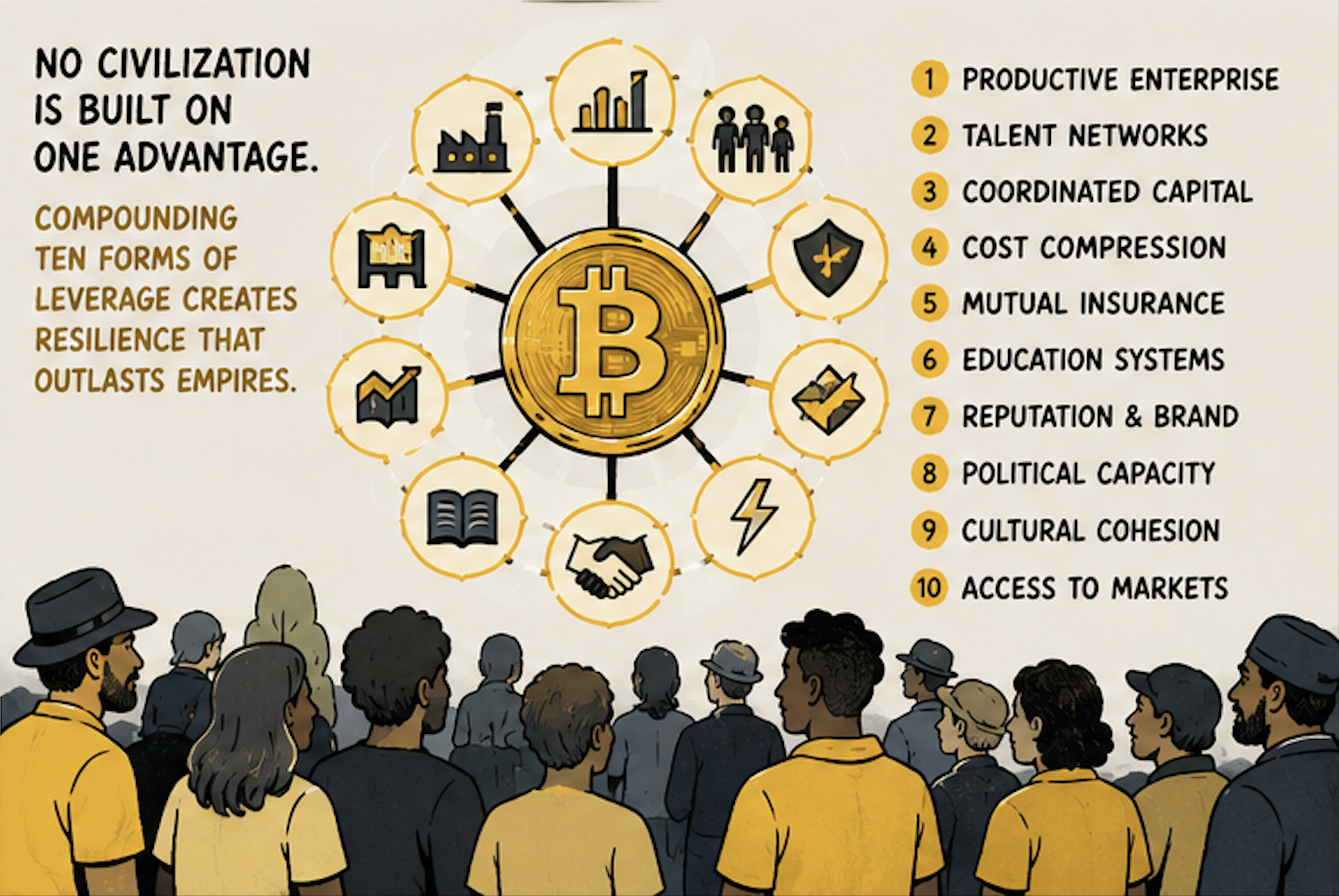
No civilization is built on one advantage
Every durable power structure combines several forms of leverage.
Saudi Arabia possesses oil, but oil alone does not explain its position. Its power also depends on production infrastructure, state capacity, financial reserves, security relationships and influence over global energy markets.
Singapore benefits from geography, but geography alone does not produce a prosperous state. It compounds port access with trade policy, infrastructure, education, public security, administrative competence and a reputation for predictability.
Apple is not powerful merely because it designs attractive products. It combines industrial design, proprietary software, semiconductor expertise, brand loyalty, global manufacturing, retail distribution, developer relationships and extraordinary access to capital.
Amazon did not become dominant through online retail alone. It joined logistics, cloud computing, data, marketplace scale, warehousing, software and a culture of operational measurement.
One advantage creates an opening.
Several reinforcing advantages create a system.
The idea of the 10x engineer expresses the same principle at the level of individual talent.
A 10x engineer is not simply a programmer who types ten times faster. The real leverage comes from making everyone else more capable.
An engineer who chooses the right architecture can prevent years of future complexity. One who builds a reusable tool can save thousands of hours across an organization. One who identifies the correct technical constraint can stop an entire company from constructing the wrong system.
Linus Torvalds did not personally build every component of the modern Linux ecosystem. His early work and continued technical stewardship helped establish an architecture around which thousands of contributors and companies could coordinate.
Margaret Hamilton’s contribution to Apollo software was not merely the volume of code she personally produced. Her leadership helped establish the software architecture and engineering discipline required for a large organization to build reliable systems under extreme constraints.
John Carmack’s influence did not come only from coding speed. His technical insights changed what teams believed real-time graphics engines could accomplish and gave later developers new foundations on which to build.
These examples should not become myths of isolated genius. Every major technical achievement depends on teams, institutions and accumulated knowledge.
The point is that certain people create leverage far beyond their own labour.
A great architect improves the work of hundreds of engineers. A great teacher improves generations of students. A disciplined capital allocator directs thousands of people and billions of dollars toward more productive uses. A trusted organizer turns strangers into a functioning institution.
Nations understand this.
They compete for scientists, engineers, entrepreneurs, physicians and investors because exceptional people do not merely add one unit of output. They create companies, train teams, transfer knowledge and build systems that continue producing after the original person steps away.
Families can produce similar leverage through coordination.
Shared housing lowers each person’s cost of living. Pooled transportation reduces capital needs. Family childcare enables more adults to work. Informal credit finances businesses that banks would reject. Older members transfer knowledge while younger members contribute labour and technical fluency.
No individual arrangement is revolutionary.
Together they can allow a family to accumulate property, education and business ownership far faster than an isolated household with the same income.
Even criminal organizations reveal part of the same structure.
The mafia creates internal leverage through loyalty, secrecy, concentrated enforcement and family ties. Its methods are coercive and destructive, but its persistence demonstrates the strategic value of reducing coordination costs inside a trusted group.
The moral character of the institution determines whether this leverage becomes productive or predatory.
Bitcoin currently offers several extraordinary advantages.
It provides a monetary asset that no participating institution can issue at will. It enables global settlement, portable capital, censorship resistance and the monetization of energy across distance.
These advantages are substantial.
They are not sufficient.
A community that possesses hard money but lacks productive businesses will spend its reserves buying the output of others.
A community with capital but no talent institutions will watch its most capable members leave.
A community with skilled people but no financing network will produce employees for other systems rather than owners of its own.
A community with wealth but no mutual insurance will fracture during hardship.
A community with strong culture but weak governance will become vulnerable to charismatic leaders and internal capture.
A community with political influence but no economic base will remain dependent on patronage.
Bitcoin becomes civilizationally consequential only when these advantages are coordinated.
The task is not to discover one final breakthrough worth everything.
It is to assemble ten advantages, each capable of multiplying the usefulness of the others.
The result is not additive.
It is compounding.
The ten forms of leverage
A Bitcoin commonwealth would need at least ten institutional capacities.
Each one solves a different form of dependence. Together they allow a dispersed people to accumulate power without requiring one state, one ruler or one territory.
1. Monetary sovereignty
Bitcoin provides the commonwealth with a reserve asset and settlement layer that no internal institution can issue at will.
This allows individuals and organizations to preserve surplus without depending entirely on the monetary policy of a host state. It also creates a shared economic language across borders.
The point is not simply to hold an appreciating asset.
The point is to establish a reserve that no internal leader can dilute to reward allies, finance vanity projects or postpone difficult decisions.
Monetary sovereignty creates discipline because failure cannot be quietly transferred to future holders through issuance.
2. Productive enterprise
Savings without production create a wealthy but dependent class.
A commonwealth must own and operate businesses that produce food, energy, software, housing, transportation, financial services and other necessities. These enterprises create employment, competence and bargaining power.
Bitcoin treasury strategy should therefore follow productivity.
A business improves its operations, creates real value, earns a surplus, maintains sufficient liquidity and accumulates bitcoin from retained earnings. The reserve strengthens the enterprise. The enterprise gives the reserve a productive social foundation.
Bitcoin should become the balance sheet of a productive economy, not an escape from the work of building one.
3. Talent concentration
Exceptional people generate disproportionate outcomes when they are placed beside complementary people, capital and institutions.
The 10x engineer is useful as a metaphor because it identifies leverage rather than effort. One person creates an architecture, tool or insight that raises the productivity of an entire network.
A Bitcoin commonwealth requires institutions capable of identifying such people early and multiplying their effect.
A capable person entering the network should gain access to apprenticeships, trusted employment, mentorship, research support, startup opportunities and geographic mobility.
The network should not merely attract talent.
It should make talented people more capable than they would be outside it.
Talent becomes power when it is coordinated.
4. Coordinated capital
Individual wealth becomes political and economic power only when it can be pooled around large objectives.
Mancur Olson’s The Logic of Collective Action explains why shared interests do not automatically produce shared investment. Everyone may benefit from legal defence, infrastructure or education, while each individual still prefers that someone else bear the cost.
A commonwealth therefore needs investment funds, credit institutions, acquisition vehicles, endowments and treasury structures capable of financing collective priorities.
These institutions must remain transparent and limited. Otherwise coordinated capital simply creates a new financial elite.
The objective is to convert scattered private wealth into productive capacity without surrendering it to unaccountable managers.
5. Cost compression
Communities become more powerful when they reduce the cost of ordinary life for their members.
Families achieve this through shared housing, pooled transportation, childcare, eldercare and family labour. Companies achieve it through economies of scale. States achieve it through infrastructure and bulk procurement.
A Bitcoin commonwealth could coordinate housing networks, health benefits, insurance, purchasing groups and shared professional services.
Lower living costs increase what each household can save, invest, educate and contribute.
Every dollar not consumed by avoidable friction becomes available for compounding.
6. Mutual insurance
A community is tested during its members’ worst years.
Illness, unemployment, disability, displacement and business failure can destroy decades of progress when every household must absorb risk alone. Traditional families and religious communities remain resilient partly because they distribute some of these shocks.
A Bitcoin culture that celebrates self-custody while abandoning members during hardship will remain a financial subculture.
Mutual-aid funds, community endowments, emergency financing and cooperative insurance can create a limited but meaningful social floor.
The obligation need not be unlimited. It should be defined, reciprocal and transparent.
Loyalty becomes durable when an institution proves useful precisely when markets are least forgiving.
7. Education and knowledge
Capital without knowledge is eventually lost.
A commonwealth needs schools, apprenticeships, research institutions and systems for transmitting practical judgment. Education must include monetary history, technology, ethics, law, business, governance and the responsibilities of ownership.
Children should inherit more than seed phrases.
They should understand how to preserve capital, operate institutions, resolve disagreements and resist the temptation to become another extractive elite.
A civilization becomes durable when competence is reproduced rather than rediscovered.
8. Reputation and commercial trust
Global coordination requires trust that can travel.
Pseudonymity protects freedom, but serious commerce still depends on knowing who completes work, honours agreements, safeguards information and remains reliable during adversity.
A Bitcoin commonwealth needs portable systems of reputation, certification, arbitration and professional membership.
These systems must remain contextual. Trusting someone as an engineer should not require surveillance of private life. A commercial dispute should not become permanent social exile.
The objective is to reduce the cost of finding reliable counterparties without creating a universal social-credit system.
Trust lowers transaction costs.
Lower transaction costs allow strangers to cooperate as though they belonged to a much smaller community.
9. Legal and political capacity
Politics does not disappear when people become disillusioned with the state.
It is simply conducted by someone else.
Bitcoiners do not need one political ideology. They need enough organization to defend basic conditions across jurisdictions: the right to hold keys, operate nodes, mine lawfully, transact voluntarily, build companies and receive fair legal treatment.
This requires lawyers, policy institutes, diplomatic relationships, litigation funds and credible political representation.
The objective is not permanent control of one state.
It is jurisdictional competition.
Governments should know that productive people, capital and infrastructure can move toward places that treat them fairly.
Political capacity turns exit from a private fantasy into a credible collective option.
10. Culture and communication
Institutions cannot survive on financial incentives alone.
Benedict Anderson’s Imagined Communities explains how language, media, symbols and shared history allow strangers to experience themselves as members of the same people.
Bitcoin already possesses a powerful mythology. It has a creation story, a missing founder, a fixed supply, a halving cycle, recognizable symbols and a history of schisms and survival.
The challenge is to turn this narrative into culture without turning it into dogma.
A healthy culture preserves memory, rewards contribution, permits criticism and gives members a reason to build for people they will never meet.
An unhealthy culture performs loyalty, protects incompetent leaders and replaces accountability with slogans.
Communication is not decoration.
It determines what the community remembers, admires and reproduces.
The leverage is multiplicative
These ten capacities do not operate independently.
Talent attracts capital. Capital finances enterprises. Enterprises create employment and surplus. Surplus strengthens reserves. Reserves make long-term investment possible. Education improves the quality of talent. Reputation makes collaboration cheaper. Mutual insurance allows households to take productive risks. Political capacity protects the institutions. Culture gives people a reason to preserve them.
The system compounds because each element increases the value of the others.
A talented population without capital becomes a labour pool for outside institutions.
Capital without productive enterprise becomes speculation.
Enterprise without political protection remains vulnerable to capture.
Political influence without culture becomes transactional lobbying.
Culture without education becomes mythology.
Education without opportunity exports its best graduates.
Mutual aid without production becomes dependency.
Bitcoin without the surrounding institutions becomes a reserve asset held by people who remain dependent on the systems they criticize.
A commonwealth emerges when the entire stack begins to reinforce itself.
This is the deeper meaning of accumulating ten different forms of 10x leverage.
The arithmetic is not literal.
The structure is.
A 10x engineer multiplies the capabilities of a team. A 10x institution multiplies the capabilities of a community. Ten reinforcing institutions can alter the historical position of a people.
Civilizational power comes from combining advantages that solve different vulnerabilities at the same time.
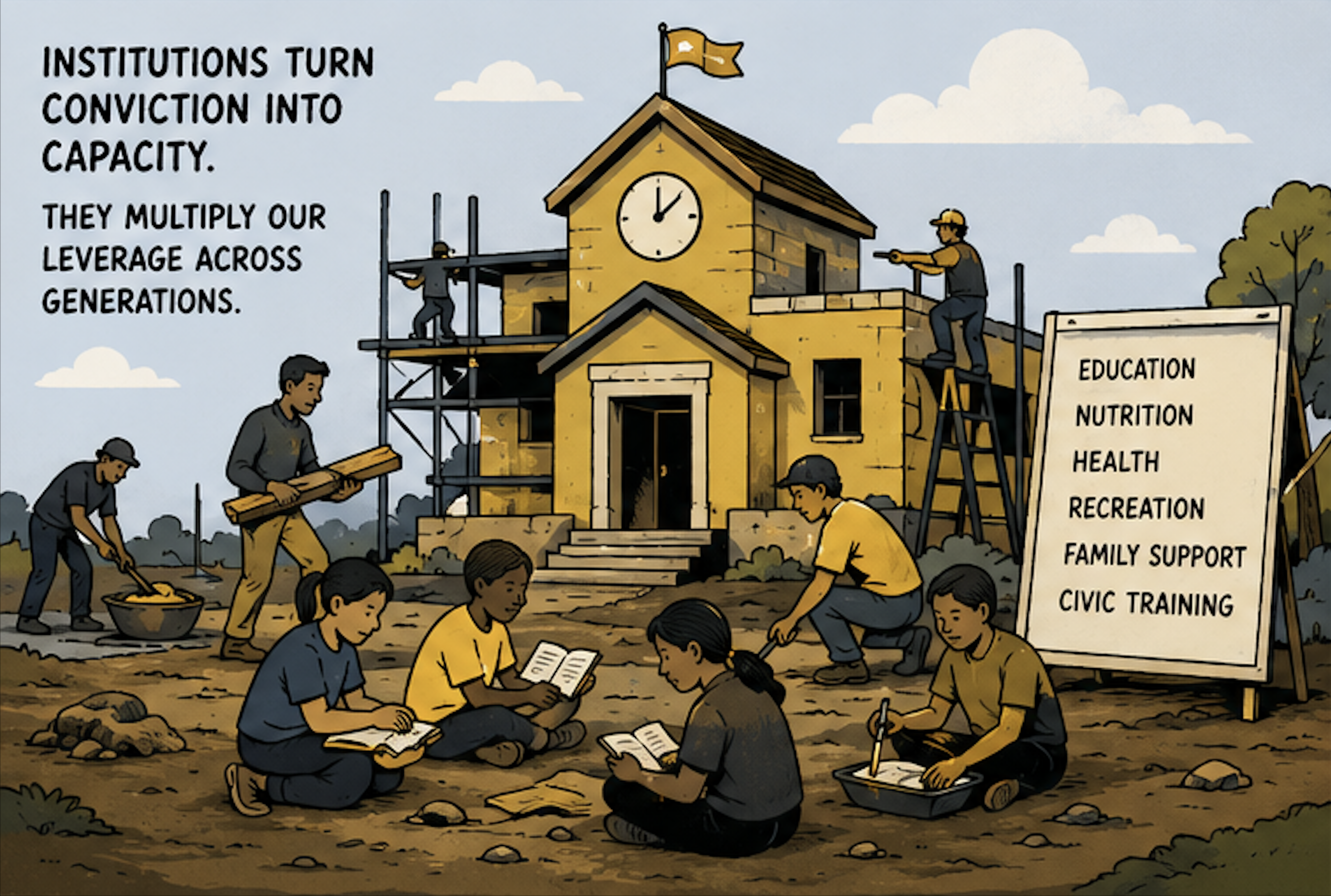
Institutions turn conviction into capacity
Shared conviction can begin a movement.
Only institutions can carry it through generations.
Religions endure because they transform belief into repeated practices. They establish schools, charities, endowments, scholarship, family customs, leadership systems and obligations toward vulnerable members. They accompany people through birth, marriage, illness and death.
Their strength does not come only from the intensity of belief.
It comes from the ability to convert belief into durable forms.
Bitcoin should not become a religion.
Religion addresses ultimate meaning, moral obligation and the nature of existence. A monetary protocol cannot honestly answer those questions. Treating Bitcoin as sacred would eventually produce priesthoods, purity contests and idolatry.
Bitcoin can provide something narrower and still profound.
It can become a monetary constitution shared by people of different faiths, nations and cultures.
Religion can supply the ultimate why.
Bitcoin can constrain part of the economic how.
The appropriate measure of commitment is therefore not whether someone would die for Bitcoin.
A dramatic sacrifice may take a moment.
Building a school takes years. Operating an honest business takes decades. Raising competent children takes a generation. Preserving an institution without capturing it for private benefit may require a lifetime.
The more serious commitment is the willingness to live under discipline.
It appears in those who save patiently, tell the truth when deception is profitable, care for others during hardship and build institutions they may never personally control.
A commonwealth, not an empire
The word commonwealth describes the intended shape better than state, corporation or movement.
A state seeks territorial authority.
A corporation serves a defined commercial purpose.
A movement mobilizes around an idea.
A commonwealth joins people through shared institutions and a conception of common flourishing.
A Bitcoin commonwealth would not require one government, one culture or one leader. It would consist of companies, schools, investment institutions, professional guilds, mutual-aid societies, research organizations, religious communities and political associations.
Each institution would have a limited purpose.
A custody federation would not govern family life. A political organization would not define religious doctrine. A business association would not control speech. A school would not determine monetary consensus.
Authority would remain distributed across functions.
Elinor Ostrom’s Governing the Commons provides the relevant institutional logic. Durable cooperation requires clear boundaries, locally appropriate rules, meaningful participation, monitoring, proportionate consequences and accessible dispute resolution.
Good intentions are not enough.
A commonwealth remains free only when its institutions are designed to resist capture.
Membership should create real benefits and real obligations. Leaders should be replaceable. Accounts should be visible to those bearing the risk. Authority should remain narrow. Exit should be practical rather than merely theoretical.
This is sovereignty without an empire.
It is stateless not because its members live outside states, but because their collective survival does not depend entirely on any single one.
Its members remain Canadian, Nigerian, Pakistani, Salvadoran, American or Indonesian. They retain their faiths, languages and local loyalties. Bitcoin does not erase those identities.
It creates another layer of belonging.
The commonwealth becomes a people when it can remember, educate, finance, employ, protect, represent and reproduce itself across generations.
The work after BIP-110
BIP-110 concerns what belongs inside Bitcoin.
The larger project concerns what must be built around it.
Bitcoin’s first great achievement was credible digital scarcity. Its next achievement must be the conversion of that scarcity into productive and institutional capacity.
The protocol cannot accomplish this by itself.
It cannot build businesses, train leaders, care for families, organize capital, establish schools or defend civil rights. It cannot prevent holders from becoming another insulated elite. It cannot guarantee that monetary wealth will become productive power rather than consumption and status.
Those outcomes depend on institutions.
The next Bitcoin frontier is therefore not simply another financial product, technical upgrade or theory of price appreciation.
It is an operating system for a distributed people.
That operating system will require tools for treasury management, productive business ownership, capital formation, talent coordination, mutual aid, education, reputation, arbitration, political representation and culture.
Some of these tools will be technical. Others will be financial, legal or social. Most will operate below the level of grand political theory, inside ordinary businesses, institutions and households.
Their collective purpose is larger.
They allow people to convert hard money into long-term independence.
They allow a dispersed community to accumulate several forms of leverage rather than relying on monetary wealth alone.
They allow Bitcoin to become more than an asset held within the existing order.
They allow it to become the monetary foundation of a parallel, productive and self-reinforcing commonwealth.
Bitcoin has already shown that money can be stateless.
The work after BIP-110 is to discover whether a people can become meaningfully sovereign without first becoming a state.